
Operations and measurement · DP093
Budgeting for DPDP readiness by workflow, not by fear
Allocate readiness effort to specific workflows, dependencies and evidence instead of buying a broad promise in response to alarming headlines.
Research cutoff: . This dated explainer is general information; check the linked instruments and your circumstances before acting.

A frightening penalty headline is a poor basis for a project budget. It can push a small business towards a large software purchase before anyone has identified the data flows, decisions or controls that need attention. The result may be a new subscription sitting on top of the same unclear process.
Build the budget from work you can describe. Identify the workflow, the gap, the owner and the evidence that will show the work has improved it.
Begin with the actual commencement position
As of 22 October 2026, most substantive DPDP business duties are scheduled for 13 May 2027 under the commencement notification. Plan against the relevant phases and current applicable obligations instead of assuming that every future requirement has already commenced.
The future section 8 framework and rule 6 safeguards provide a starting point for assessing ordinary responsibilities. Additional Significant Data Fiduciary work under section 10 and rule 13 should not be presented as an identical requirement for every small business.
Penalty figures also need their statutory context. Section 33 and the Schedule set category-specific maximums and an inquiry-based process; they are not automatic invoices generated whenever a gap is found. That distinction supports a reasoned plan without minimising the need to address real weaknesses.
Estimate by workflow
Choose the processes that handle personal data: customer intake, delivery, promotions, employee administration, support and provider access. For each, record the current state and the unresolved decision or control.
Separate the work into process changes, technical configuration, staff time, supplier work and focused specialist advice. A confusing notice may need a purpose review before editing. A failed withdrawal path may need an integration change before another training session. The budget should reflect that dependency.
Include internal effort. Someone must inspect the current flow, test the change, handle exceptions and maintain the result. A vendor quotation that omits those tasks does not describe the full cost of the operational change.
A hypothetical small-business plan
A retailer identifies three gaps: optional promotional choices are bundled at the counter, former staff accounts are not consistently removed, and nobody can explain where old delivery exports remain. The owner writes three work packages rather than requesting a general compliance package.
The first package changes the counter script, billing configuration and campaign export, then tests a customer who declines promotions. The second assigns account ownership and verifies removal across the relevant systems. The third maps retained delivery copies and resolves the purpose and retention questions before automating deletion.
Each package has a responsible person, a dependency and a completion test. The owner can compare the effort and consequences without pretending that a single price buys a finished legal status.
Prioritise the gaps that affect real control
Consider the sensitivity and context of the data, the people affected, the breadth of access, the consequences of a failure and whether a gap blocks several other improvements. Record the reasoning in plain language. A simple prioritisation method is useful if its assumptions remain visible.
Do not postpone a serious access problem merely because drafting a policy is easier to count as progress. Conversely, do not buy complex infrastructure where a narrower field, a removed export or a clear owner addresses the actual issue.
Some questions need specialist input. Scope that work around the decision you need, such as a particular retention obligation, transfer arrangement or children’s feature. A focused question is easier to answer and budget for than a request to declare the entire business compliant.
Compare tools against the unfinished process
Before purchasing, ask which part of the work the tool performs, what you must configure and which decisions remain yours. Test the relevant workflow with synthetic records. Check the output evidence, failure behaviour, access model and exit options.
Avoid pricing comparisons based only on headline features. A service that requires substantial integration or manual review may still be worthwhile, but those tasks belong in the estimate. Do not invent a return-on-investment percentage without measured costs and outcomes.
Reserve effort for maintenance
New staff, tools, recipients and purposes can change the data path. Assign time for periodic review and change-triggered updates. Keep evidence of the controls you rely on and revisit unresolved items rather than treating launch as the end of the work.
A budget cannot purchase certainty about every privacy decision. A useful readiness budget funds specific decisions and changes that people can inspect. When each item has a scope, owner and completion test, the business can make trade-offs without relying on fear or a vague promise of total compliance.
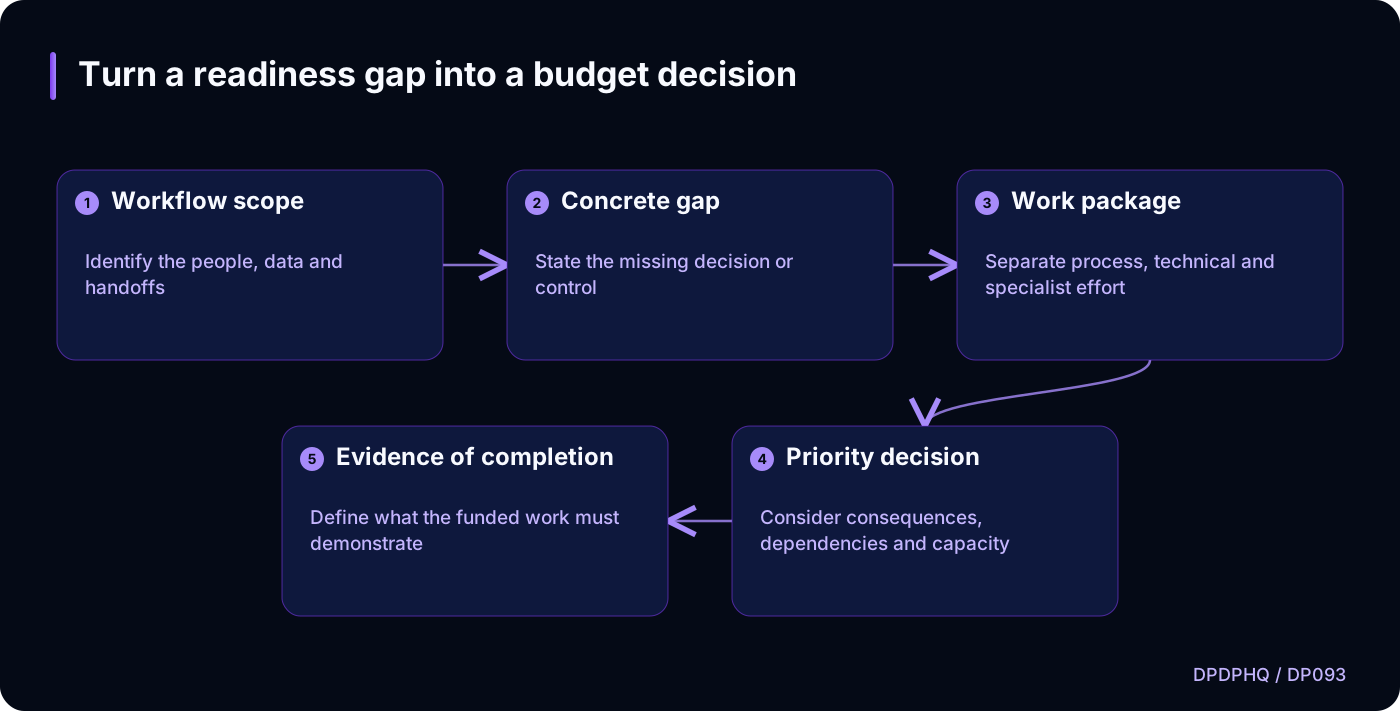
Turn a readiness gap into a budget decision
Text version of the diagram
- Workflow scope: Identify the people, data and handoffs
- Concrete gap: State the missing decision or control
- Work package: Separate process, technical and specialist effort
- Priority decision: Consider consequences, dependencies and capacity
- Evidence of completion: Define what the funded work must demonstrate
- Workflow scope → Concrete gap
- Concrete gap → Work package
- Work package → Priority decision
- Priority decision → Evidence of completion
Sources and reading context
These references support the original 22 October 2026 research. Source links and the date above make the scope of this article explicit.
- Commencement notification for provisions of the DPDP Act · paragraph (c)
Dates substantive obligations
- Digital Personal Data Protection Act, 2023 · sections 8, 10, 33 and Schedule
Responsibilities, SDF distinctions and bounded penalty context
- Digital Personal Data Protection Rules, 2025 · rules 6 and 13
Safeguards and SDF-specific work