
Education and children · DP065
Preparing an admissions enquiry form for DPDP
Design admissions enquiries as an early, limited interaction rather than collecting a complete student file before it is needed.
Research cutoff: . This dated explainer is general information; check the linked instruments and your circumstances before acting.

An admissions enquiry is often just a parent’s request for fees, availability or a visit. Yet some forms ask for the child’s full date of birth, home address, identity documents, previous reports and medical information before answering that first question. The institution has moved several stages ahead of the family’s actual need.
Build the form around the enquiry stage. Decide which questions help the admissions team respond now and which belong only in a later, justified application process.
Start with the smallest useful conversation
A general enquiry may need an adult contact, the programme or year group of interest and a suitable follow-up route. Even then, explain what will happen after submission. An enquiry about one course should not silently become permission for every future campaign from the institution and its partners.
As of 22 October 2026, the relevant substantive DPDP duties are scheduled for 13 May 2027 under the commencement notification. For consent-based collection, the future sections 5 and 6 and rule 3 will require a usable notice and appropriate consent. Treat the redesign as preparation for those duties and review existing applicable obligations separately.
An early-stage form can explain its specific purpose without reproducing the institution’s entire legal handbook. Link the relevant follow-up and contact routes in a form the person can actually use. Test the notice on the same small screen on which the enquiry is likely to be submitted.
Recognise when the form starts processing child data
Collecting a parent’s number does not automatically mean the form contains only the parent’s data. A child’s name, age, identifiable educational history or attached report changes the analysis. If that information is needed, assess the future section 9 children framework, including the relevant verifiable parental-consent requirements and any precisely applicable exception.
Rule 10 addresses parental verification, while rule 12 and the Fourth Schedule contain conditional exceptions. The fact that an organisation provides education does not exempt every admissions or marketing activity. Do not copy a broad ‘school exemption’ label onto the enquiry process without reading its conditions.
Where the initial question can be answered without identifying the child, consider keeping that stage limited. That is a practical design choice, not a claim that all child-data questions can be postponed in every admissions setting.
A hypothetical training-centre enquiry
A training centre offers courses for adults and teenagers. Its original enquiry form requires a student photograph and identity-document upload. The admissions team confirms that those documents are not used to answer questions about course dates or fees.
The centre removes those uploads from the enquiry stage. It distinguishes an adult asking for themselves from an adult asking about a child, and routes any later collection of necessary child information through the assessed process. The initial response provides the requested course information without adding the contact to unrelated partner promotions.
If the family proceeds to an application, the next stage explains why additional fields are needed and who will use them. The institution can now describe the transition instead of pretending that one initial click covered every future interaction.
Review free text and attachments
An open comment can invite families to disclose health details, family circumstances or a child’s past difficulties. Ask a focused question and tell people what information is useful at this stage. Provide an appropriate separate route where a sensitive matter genuinely needs discussion.
Disable unnecessary uploads. If documents are required later, specify the document and the relevant content rather than requesting an unrestricted bundle. Limit access to the staff who handle that stage, and avoid sending application attachments through broad internal mailing lists.
Give an enquiry an ending
Decide what happens if the person never applies, declines further contact or asks for a different programme. Set an owner and a review event for the record. Assess applicable retention requirements rather than choosing indefinite storage because a lead may someday become valuable.
When an enquiry becomes an admitted student’s record, move only the information needed for the next purpose and preserve relevant permissions and corrections. Admissions staff’s informal notes about a family’s likelihood to enrol may have no place in a teacher’s working view.
The common failure is a form designed around every possible future need. A staged form is easier to explain and easier to maintain. Each new field should answer two questions: why is it needed at this stage, and what will the institution do with it after this stage ends?
Collect information in the right admissions stage
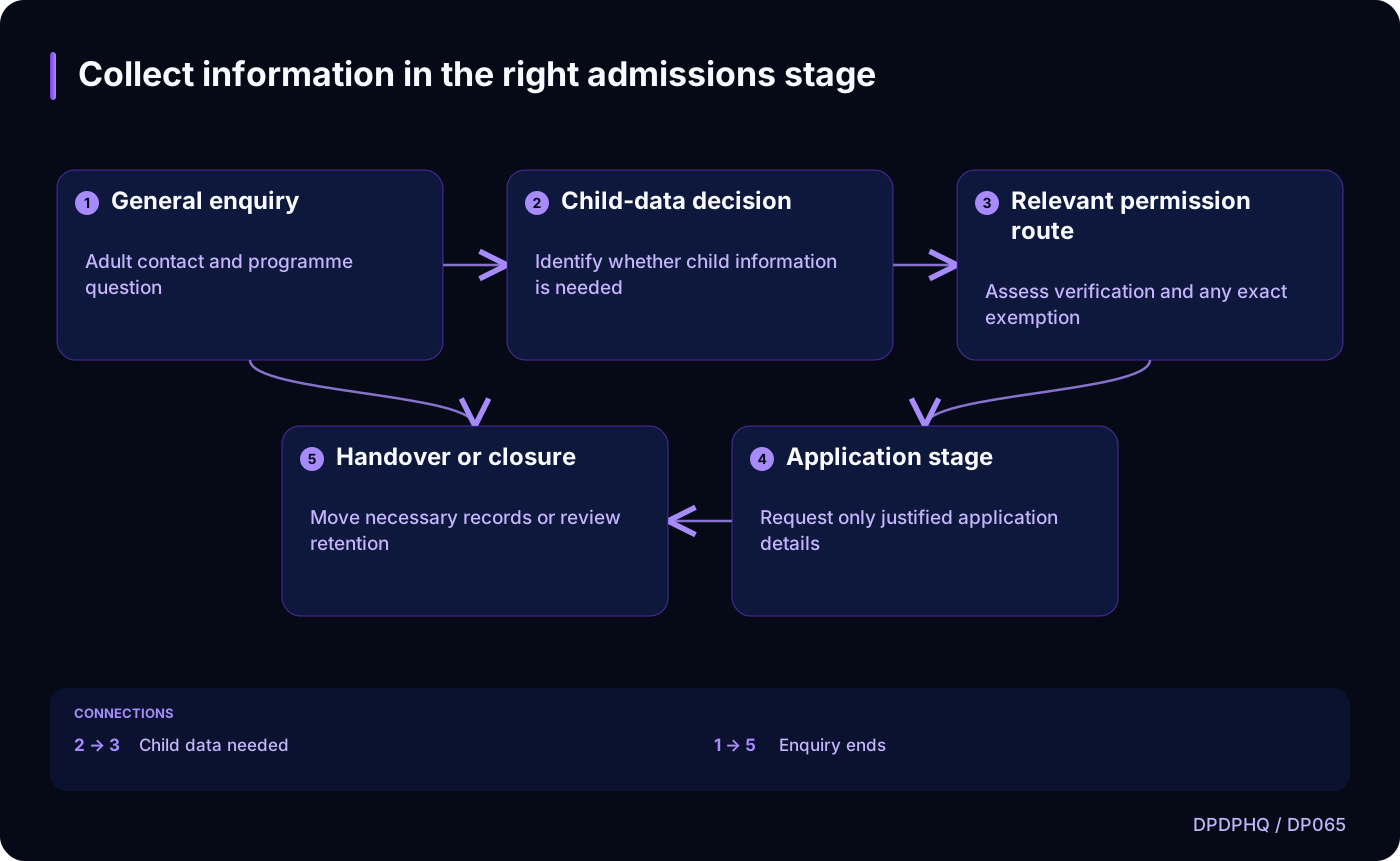
Text version of the diagram
- General enquiry: Adult contact and programme question
- Child-data decision: Identify whether child information is needed
- Relevant permission route: Assess verification and any exact exemption
- Application stage: Request only justified application details
- Handover or closure: Move necessary records or review retention
- General enquiry → Child-data decision
- Child-data decision → Relevant permission route: Child data needed
- Relevant permission route → Application stage
- General enquiry → Handover or closure: Enquiry ends
- Application stage → Handover or closure
Sources and reading context
These references support the original 22 October 2026 research. Source links and the date above make the scope of this article explicit.
- Commencement notification for provisions of the DPDP Act · paragraph (c)
Clarifies commencement
- Digital Personal Data Protection Act, 2023 · sections 5, 6, 9
Notice, consent and children framework
- Digital Personal Data Protection Rules, 2025 · rules 3, 10 and 12; Fourth Schedule
Notice, parental verification and limited exemptions