
Retail and local businesses · DP057
Privacy at the billing counter: phone numbers, receipts and choice
Separate the sale, the receipt and future marketing so customers can understand why a shop asks for their phone number.
Research cutoff: . This dated explainer is general information; check the linked instruments and your circumstances before acting.

Imagine a customer buying a notebook and hearing, ‘Phone number, please.’ The cashier sees a mandatory field. The customer hears a condition of purchase. Neither has been told whether the number is needed for a receipt, a delivery, a warranty record or next month’s promotional messages.
That small exchange is a useful place to begin privacy work. The first improvement is to make the purpose explicit before deciding what a form or point-of-sale system should require.
Separate three conversations
A completed sale, an electronic receipt and a marketing relationship are separate activities. A contact detail that helps with one does not automatically justify the others. Ask your billing provider which fields are configurable, which downstream lists receive the details and what happens when a customer declines an optional use.
As of 22 October 2026, the substantive DPDP provisions discussed here are scheduled for 13 May 2027 under the commencement notification. This is a readiness exercise. Existing requirements for particular transactions still need to be checked; DPDP does not settle every tax, warranty or sector-specific question about an invoice.
Under the coming framework, processing will need a lawful purpose and an appropriate route under sections 4 and 7. Consent is one route. Section 7(a) concerns data voluntarily provided for a specified purpose where the individual has not indicated refusal. That is a bounded provision, not permission to treat every number supplied at a counter as promotional consent.
Explain the request in ordinary language
If you rely on consent, sections 5 and 6 will require the relevant notice and clear affirmative, purpose-specific consent. Rule 3 will add independently understandable notice content. The law does not prescribe one universal counter script or require a checkbox for every conversation.
A practical proposed script is: ‘Would you like the receipt sent to your phone? We will use the number for that receipt. Offers are a separate choice.’ Adapt the wording to what your system actually does. Do not promise receipt-only use if the number is automatically added to a marketing tool.
Staff also need an answer when a customer asks why a field is compulsory. ‘The system asks for it’ describes a software configuration, not the underlying purpose. If the shop can complete the sale without the number, provide that route. If a particular transaction requires contact information, explain the specific reason and offer a workable alternative where possible.
A hypothetical hardware-shop purchase
Imagine a hardware shop selling a hinge over the counter. The customer takes the item immediately and accepts a paper receipt. The shop has no delivery task. Its owner checks the billing settings and removes the mandatory phone field for that ordinary transaction.
Later, another customer orders a custom item for collection. The shop asks for a contact route to confirm that it is ready. The customer’s number is linked to that order and its stated purpose. The cashier separately asks whether the customer wants future offers, without making the order conditional on that choice.
The owner tests both paths. Declining offers still allows the order to be completed. The marketing export contains only the appropriate records, and a staff member can explain the difference without reading a long policy aloud.
Check what the number does after collection
Follow one test record through the billing system. Does it enter a loyalty programme? Is it available to every employee? Is it exported to a campaign list? Do receipt messages contain unrelated promotions? A clear counter explanation fails if the downstream workflow contradicts it.
Keep the evidence proportionate. For a consent-based promotional purpose, record the relevant choice and notice version in a way you can connect to that person and purpose. Avoid retaining audio of every customer conversation merely to prove a simple preference unless there is a separately justified need and appropriate safeguards.
Give cashiers a simple escalation route
Train staff to distinguish required transaction information from optional extras, and to pause when a customer challenges the request. Give one responsible person authority to correct a configuration or explain an exception. A cashier should not have to improvise a legal position during a queue.
The recurring failure is a useful-sounding explanation attached to an unchanged system. Review the form, the script and the actual data flow together. A customer who chooses a receipt should receive the service they understood, with any further relationship based on a clear, separate decision.
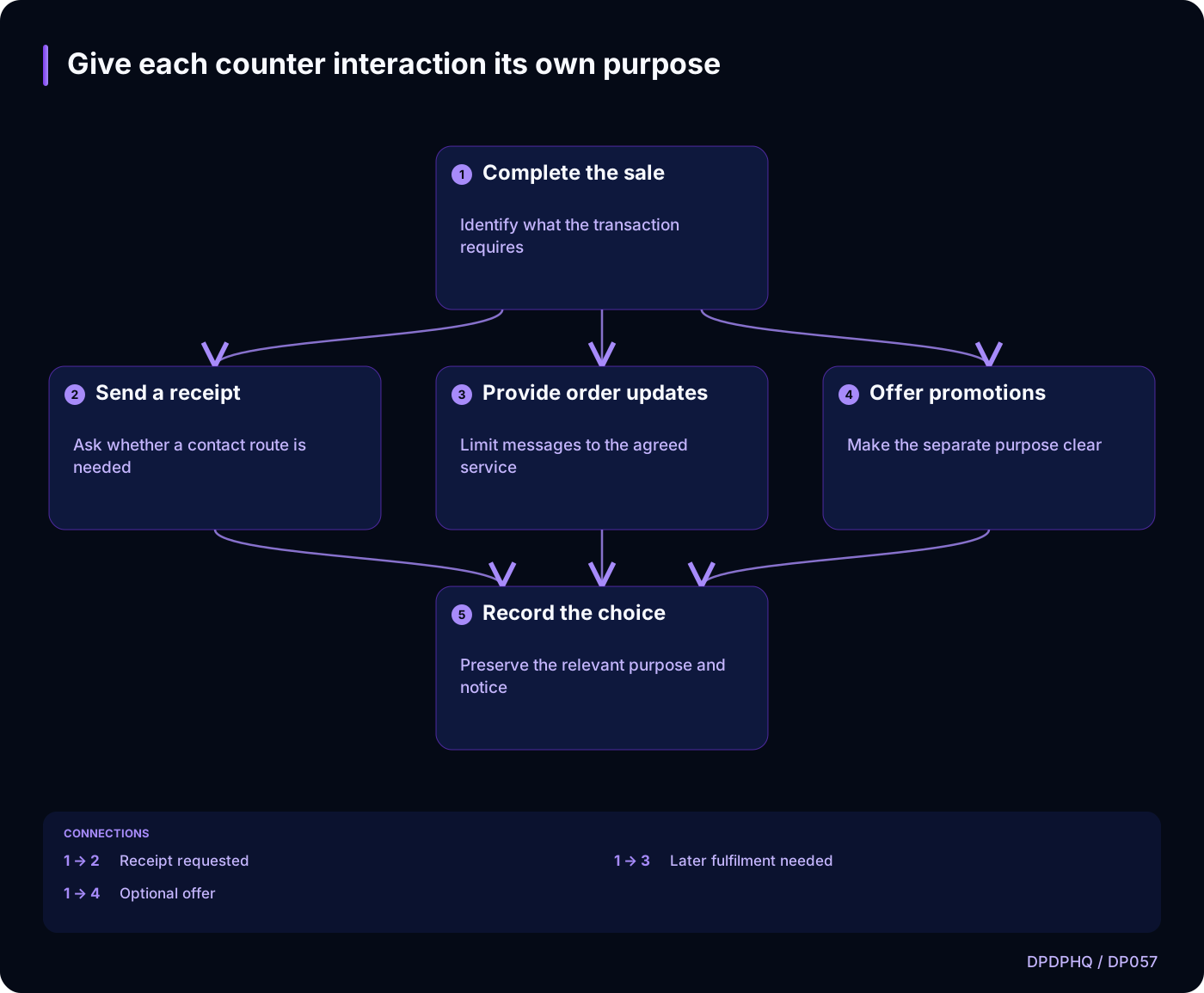
Give each counter interaction its own purpose
Text version of the diagram
- Complete the sale: Identify what the transaction requires
- Send a receipt: Ask whether a contact route is needed
- Provide order updates: Limit messages to the agreed service
- Offer promotions: Make the separate purpose clear
- Record the choice: Preserve the relevant purpose and notice
- Complete the sale → Send a receipt: Receipt requested
- Complete the sale → Provide order updates: Later fulfilment needed
- Complete the sale → Offer promotions: Optional offer
- Send a receipt → Record the choice
- Provide order updates → Record the choice
- Offer promotions → Record the choice
Sources and reading context
These references support the original 22 October 2026 research. Source links and the date above make the scope of this article explicit.
- Commencement notification for provisions of the DPDP Act · paragraph (c)
Dates the substantive framework
- Digital Personal Data Protection Act, 2023 · sections 4, 5, 6 and 7(a)
Distinguishes processing routes and purpose-specific consent
- Digital Personal Data Protection Rules, 2025 · rule 3
Explains the future notice requirement