
Retail and local businesses · DP060
QR-code feedback forms: collect less and explain more
Make a QR feedback form useful without asking every customer for an identifiable profile.
Research cutoff: . This dated explainer is general information; check the linked instruments and your circumstances before acting.

Consider a hypothetical café that wants to know whether orders are arriving hot. Its QR-code form asks for a name, phone number, email address, date of birth and social-media handle before accepting a rating. Most of those fields do not help answer the café’s question. They make a small feedback exercise into a much larger collection of personal data.
A better form begins with the decision the business wants to make. If the aim is to identify slow service during lunch, an approximate visit period and a relevant comment may be more useful than a detailed customer profile.
The code is a doorway, not a permission
Scanning a QR code generally takes a person to a destination or provides information. It does not by itself establish permission for every purpose on the page. The meaningful interaction happens when the person sees the form, understands the proposed use and takes the relevant action.
As of 22 October 2026, the substantive DPDP provisions discussed here are scheduled for 13 May 2027 under the commencement notification. In that future framework, consent-based collection will need to meet sections 5 and 6, including purpose-specific information and the necessary-data limit. Rule 3 will require a notice understandable independently of other material. The steps below are practical preparation.
Choose between feedback and follow-up
Ask whether the business needs to identify the respondent. Some feedback can inform a service decision without a contact detail. Where a customer wants a reply, provide a separate route for that request and explain how the supplied detail will be used.
This does not mean an apparently blank name field makes a form anonymous. Under section 2(t), identifiability can arise by or in relation to the data. A response may contain an order number, an address, a recognisable complaint or another identifier. The form provider’s configuration may also record identifiers. Check the actual setup before promising anonymity.
Keep the form’s language accurate. ‘Your name is optional’ is a narrower claim than ‘This response cannot identify you.’ If you cannot establish the latter, do not use it. Also consider a short prompt asking customers not to include other people’s private details in an open comment.
A hypothetical café redesign
The café replaces its original form with three relevant questions: what was ordered, the approximate visit period and what could improve. A customer can submit without entering contact details. A separate optional section allows the customer to request a reply through one chosen contact route.
The owner tests the form on a phone. The optional section remains optional, the submission works without it and the reply request is visible to the person handling follow-up. Promotional enrolment is not hidden inside that request. If the café later wants to offer a mailing list, it assesses and explains that separate purpose.
The owner also checks the form provider’s settings and exports. If a technical identifier is collected, the café considers why it is needed, who can access it and how long it remains. The published explanation is adjusted to match the result of that check.
Review the free-text field
Free-text feedback can be valuable, but it can also contain information the business never intended to collect. A customer may describe another customer’s behaviour, disclose health information or paste a full receipt. Decide who reads responses and how they should handle unnecessary detail.
A practical approach is to limit access to the people resolving the issue, avoid forwarding raw responses to a broad staff group and use de-identified summaries where they genuinely suffice. Removing a name alone may not remove identification if the incident and timing remain distinctive.
Do not make every optional concern into another mandatory field. The goal is a useful, proportionate feedback process, with an escalation route for exceptional responses.
Keep the provider relationship visible
Find out where responses are stored, which accounts can export them and whether a form link can be changed by someone else. The future section 8(1) accountability framework will not disappear because a third party hosts the form. Assess the provider’s role and your responsibilities for the particular service.
Review the QR destination periodically and after changes to the form. A printed code can remain on tables long after its original owner has left. Keep an internal owner for the destination, the notice and the response workflow.
The most useful final test is simple: can a customer give the intended feedback without supplying unrelated details, and does the business use the response as explained? If either answer is unclear, fix that path before adding another question.
Choose what the feedback task actually needs
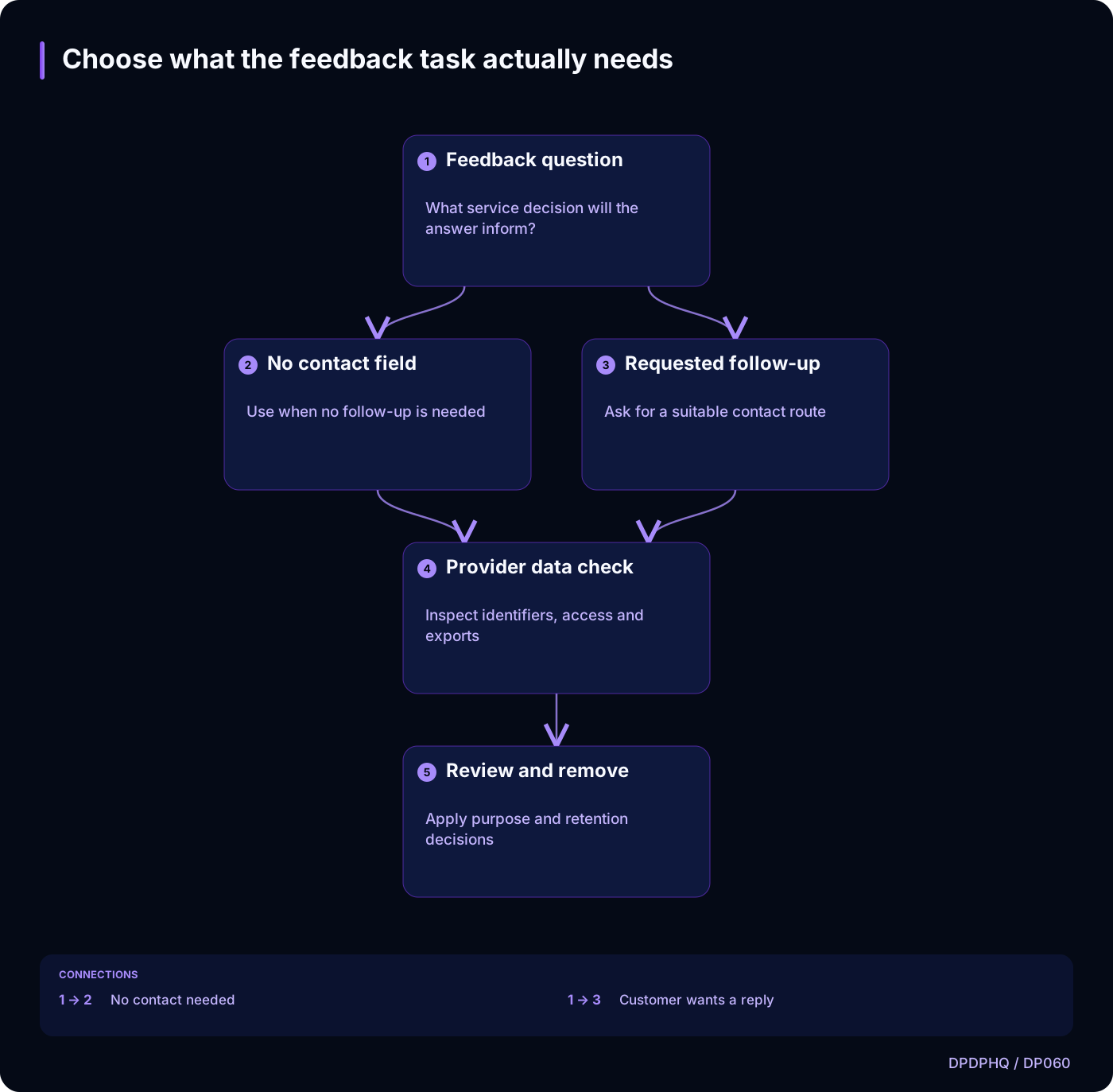
Text version of the diagram
- Feedback question: What service decision will the answer inform?
- No contact field: Use when no follow-up is needed
- Requested follow-up: Ask for a suitable contact route
- Provider data check: Inspect identifiers, access and exports
- Review and remove: Apply purpose and retention decisions
- Feedback question → No contact field: No contact needed
- Feedback question → Requested follow-up: Customer wants a reply
- No contact field → Provider data check
- Requested follow-up → Provider data check
- Provider data check → Review and remove
Sources and reading context
These references support the original 22 October 2026 research. Source links and the date above make the scope of this article explicit.
- Commencement notification for provisions of the DPDP Act · paragraph (c)
Dates the future duties
- Digital Personal Data Protection Act, 2023 · sections 2(t), 5, 6(1), 7(a), 8(1)
Supports identifiability, purpose and responsibility
- Digital Personal Data Protection Rules, 2025 · rule 3
Supports usable notice design