
Employment and service sectors · DP077
Travel bookings create a chain of personal data handoffs
Map travel information across booking participants and share the fields each recipient actually needs.
Research cutoff: . This dated explainer is general information; check the linked instruments and your circumstances before acting.

A travel booking can move through an agency, an airline, a hotel, a local operator and a payment service. The traveller experiences one itinerary, but their information follows several paths. A passport copy sent to everybody in the chain is rarely a useful substitute for understanding those paths.
Begin with the service requested and identify what each participant actually needs. The aim is to complete the journey accurately while avoiding unnecessary circulation of personal documents and contact details.
Distinguish the roles in the chain
Under section 2(i) and 2(k), a Data Fiduciary determines purposes and means, while a processor acts on its behalf. A travel supplier may have its own responsibilities and purposes. Do not label every airline, hotel or operator a processor merely because the agency makes the booking.
As of 22 October 2026, the relevant substantive DPDP duties are scheduled for 13 May 2027 under the commencement notification. The future sections 4 to 7 will require an appropriate processing route. Assess that route against the actual booking and purpose; do not import a general contractual-necessity ground that the Act does not state.
Write a short recipient map identifying the task, the data supplied, the role assessment and the contact for a correction or issue. The map can be simple, but it should distinguish the recipients rather than calling the whole chain ‘partners’.
Ask for documents at the stage they are needed
A particular journey may require identity or travel-document information. Verify the relevant requirement instead of asking every enquirer for a full document image before an itinerary is even selected. Where specific fields suffice, consider whether an entire copy is necessary.
Check free-text notes. A special request may reveal personal circumstances that only one supplier needs to know. Keep the explanation limited to the task and avoid forwarding the traveller’s entire conversation as an instruction.
Group bookings need the same care. One organiser’s convenience does not automatically resolve the position of every traveller whose information appears in the spreadsheet. Identify an appropriate route for collecting and confirming the relevant details, including any additional assessment for children.
A hypothetical family itinerary
A small agency arranges transport and accommodation for a family. It creates a booking checklist that separates the transport fields from the hotel’s requirements. Staff verify the current requirements for the specific journey rather than sending the same complete document bundle to both recipients.
One traveller corrects the spelling of a name. The agency tracks which bookings use that field and confirms the correction with each relevant recipient. It does not assume that editing the agency’s own spreadsheet changes the external reservations.
The family also asks for a particular accommodation arrangement. The agency shares the minimum relevant instruction with the hotel and keeps unrelated family information out of the transport booking. The operational result is a clearer handoff as well as a narrower disclosure.
Review overseas access without using shortcuts
Travel can involve recipients outside India. The future section 16 and rule 15 framework needs to be checked alongside any applicable sector requirements and subsequent official restrictions. Do not claim that DPDP requires all personal data to remain in India, or that every international handoff is unrestricted.
Record where the relevant recipient and support access are located, what the recipient receives and which conditions apply to the specific arrangement. A general statement that the supplier is international does not perform that analysis.
Control working copies and changes
Booking operations can create downloads, screenshots, email attachments and messaging copies. Put those routes into the process. Restrict access, use approved sharing methods and ensure staff can identify the latest version of a document or instruction. The future rule 6 safeguards will be relevant to these controls.
After the journey, assess what remains necessary for service issues, disputes and applicable retention. The future rule 8(3) and Seventh Schedule are part of that assessment. Do not promise immediate deletion of every booking record, and do not retain every working document indefinitely merely because another booking may follow.
Where processing is on the agency’s behalf, the future section 8(1) accountability framework remains important. Give external providers clear instructions and an escalation route.
The recurring failure is treating the itinerary as one permission to circulate everything. A recipient-by-recipient map lets the agency explain each handoff, correct the right records and close unnecessary copies when their work is done.
Give each booking recipient the needed fields
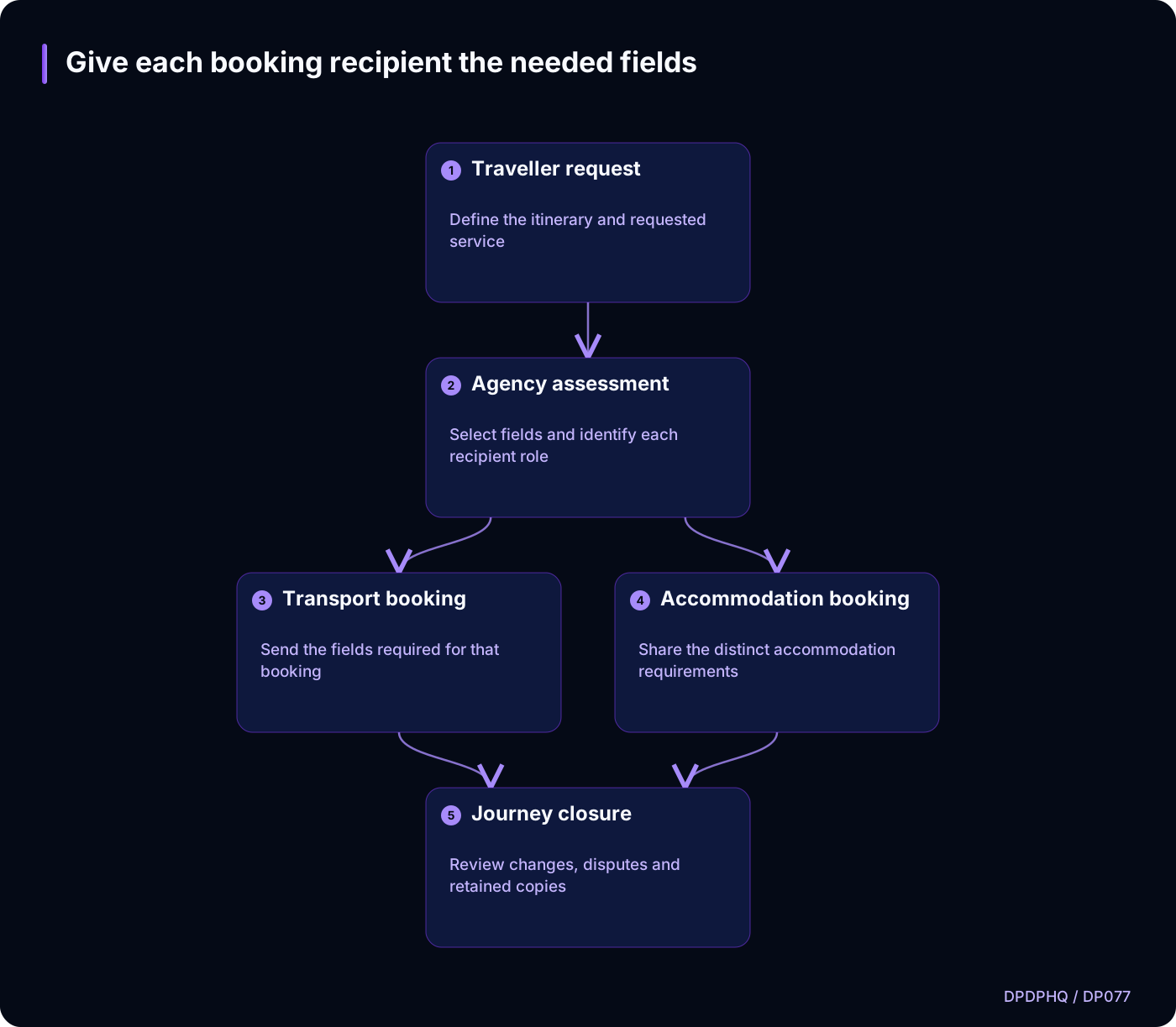
Text version of the diagram
- Traveller request: Define the itinerary and requested service
- Agency assessment: Select fields and identify each recipient role
- Transport booking: Send the fields required for that booking
- Accommodation booking: Share the distinct accommodation requirements
- Journey closure: Review changes, disputes and retained copies
- Traveller request → Agency assessment
- Agency assessment → Transport booking
- Agency assessment → Accommodation booking
- Transport booking → Journey closure
- Accommodation booking → Journey closure
Sources and reading context
These references support the original 22 October 2026 research. Source links and the date above make the scope of this article explicit.
- Commencement notification for provisions of the DPDP Act · paragraph (c)
Dates substantive duties
- Digital Personal Data Protection Act, 2023 · sections 2(i), 2(k), 4 to 7, 8(1), 16
Roles, purpose, accountability and transfers
- Digital Personal Data Protection Rules, 2025 · rules 6, 8(3), 15; Seventh Schedule
Safeguards, retention and transfer conditions