
Consent and notice · DP012
What clear affirmative consent looks like at a shop counter
Design a shop-counter consent process that staff can explain, customers can choose and the business can evidence without collecting unnecessary identity data.
Research cutoff: . This dated explainer is general information; check the linked instruments and your circumstances before acting.

A shop assistant asks, “Phone number?” The customer provides it, assuming it is needed for a repair update. The till automatically enrols the number in promotional messaging. The problem begins before any database field: the customer and the shop understood the conversation differently.
The DPDP Act’s prospective consent standard requires a clear affirmative action and consent that is free, specific, informed, unconditional and unambiguous. It also limits consent to data necessary for the stated purpose. As of 22 October 2026, most consent duties are scheduled for May 2027. The references are section 6, the final notice rule and the commencement notification.
Decide what the counter is asking
Start with the workflow. Does the shop need a number for a delivery, a repair notification, a loyalty account or optional offers? Those purposes should not disappear into one question. Staff need a short explanation that matches the information recorded by the system.
Consider a hypothetical shoe shop arranging a special-size order. The assistant explains that the number will be used to tell the customer when the shoes arrive. The shop separately asks whether the customer wants promotional messages. The example illustrates purpose separation; the business must still assess the appropriate legal ground for each activity.
If the optional choice is declined, the special order should proceed according to its actual requirements. Staff should not imply that the customer must accept unrelated marketing simply because the system makes that the easiest path through checkout.
Choose an action the customer understands
A clearly explained digital selection, a signed paper choice later entered accurately, or another demonstrable affirmative action may form part of the design. The Act does not prescribe one universal OTP, signature or hardware device for every consent event.
The important questions are what the person was told, what they chose and what evidence supports that account. An assistant ticking a box without asking the customer does not become the customer’s affirmative action merely because the database records a timestamp.
Avoid forcing customers to share additional identity documents just to join a low-risk mailing list unless a separate justified requirement exists. More collected data can create another problem without resolving whether the original choice was informed.
Keep the explanation available
At a busy counter, the full notice should be accessible through a workable route. A QR code can help some customers, but it may not help someone without a smartphone or with limited connectivity. Consider a readable printed version or an assisted route that preserves the customer’s own decision.
Rule 3 expects a notice understandable independently of other information and clear routes for withdrawal and rights. The Act also provides a language option. A staff script should therefore point to information customers can actually access, not simply mention that a policy exists somewhere online.
Test the counter flow during realistic conditions. A queue, noisy shop or shared terminal can change whether the explanation is heard and whether the right person’s choice is recorded. Training should include how to pause when the customer is uncertain.
Build evidence into normal work
The record can connect the customer reference, purpose, notice version, choice, time and collection channel. The exact format is an implementation decision. Under section 6(10), the fiduciary will need to prove notice and consent when consent-based processing is questioned in a proceeding.
Do not collect an audio recording of every counter conversation simply because it seems like stronger evidence. Assess necessity, notice, access and retention before introducing another form of personal-data processing. A well-designed transaction record may be more proportionate for the situation.
If paper is used, define who enters the choice and how entry errors are checked. A legible refusal must not become a positive flag because the form was rushed or the software defaulted to yes.
Practise the refusal and the withdrawal
Ask staff to complete the transaction when a customer declines optional promotions. Then ask them to handle a later withdrawal. Can they find the correct record, stop the relevant use and explain any separate service or retention position without argument?
Track the failure modes found in that exercise. They often involve incentives, screen defaults or unclear ownership rather than missing legal prose. A staff member rewarded only for enrolment numbers may need clearer instructions about valid choices.
A good counter process lets the customer understand and decide while giving the shop reliable evidence. It should work for an unhurried explanation and for an ordinary Saturday queue, without turning a routine purchase into pressure to surrender unrelated permissions.
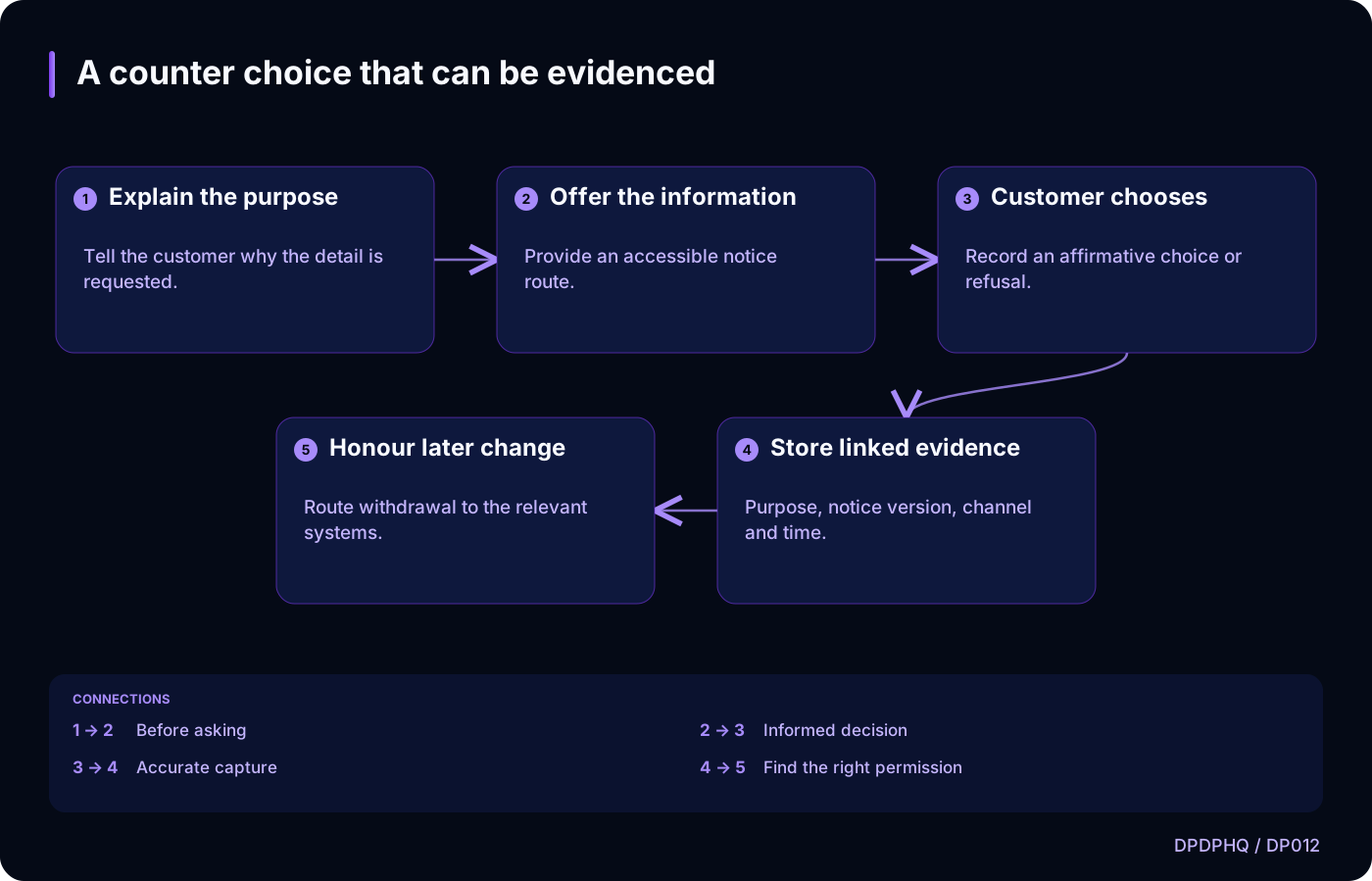
A counter choice that can be evidenced
Text version of the diagram
- Explain the purpose: Tell the customer why the detail is requested.
- Offer the information: Provide an accessible notice route.
- Customer chooses: Record an affirmative choice or refusal.
- Store linked evidence: Purpose, notice version, channel and time.
- Honour later change: Route withdrawal to the relevant systems.
- Explain the purpose → Offer the information: Before asking
- Offer the information → Customer chooses: Informed decision
- Customer chooses → Store linked evidence: Accurate capture
- Store linked evidence → Honour later change: Find the right permission
Sources and reading context
These references support the original 22 October 2026 research. Source links and the date above make the scope of this article explicit.
- Digital Personal Data Protection Act, 2023 · Sections 5 and 6
Notice, consent, evidence and withdrawal
- Digital Personal Data Protection Rules, 2025 · Rule 3
Usable notice requirements
- Commencement notification for provisions of the DPDP Act · Paragraph (c)
Later phase