
AI data paths · SW028
Deleting a source document should trigger an index review
Connect source deletion to chunks, vector indexes, caches and exports, then verify each required outcome without assuming one delete removes every copy.
Research cutoff: . This dated explainer is general information; check the linked instruments and your circumstances before acting.
SWARN is in development. Product workflows described here are design and evaluation guidance; availability depends on the published product status and agreed scope.

Deleting a source file does not necessarily remove the chunks that were indexed from it. A retrieval system may continue to hold text, embeddings, cached answers and metadata derived from that file.
The deletion workflow therefore needs a record of relationships, not just a button beside the source document. It should identify which derived objects exist, which copies are within the service’s control and what evidence establishes that each required action has completed.
Make lineage a prerequisite
At ingestion, assign a stable source reference and record the source version. Associate chunks and index records with that reference, along with the tenant and relevant access scope.
Without this relationship, deletion may rely on searching for similar text or reconstructing identifiers from filenames. That is fragile when documents have been renamed, updated or split differently by a new chunking configuration.
A hypothetical policy assistant indexes an uploaded staff handbook. The replacement edition removes a section that should no longer be available. The system needs to identify derived records from the old edition without deleting unrelated material that happens to contain similar wording.
Keep ingestion and deletion designs together. Every new derived store creates another lifecycle responsibility.
Define the deletion request precisely
A request might mean replacing one version, withdrawing a document from search, removing an accidentally uploaded file or responding to a personal-data erasure decision. These are different reasons with potentially different retention and evidence requirements.
Record the authorised instruction, scope and affected versions. Resolve any applicable retention requirement through the responsible process rather than allowing the index worker to improvise a legal decision.
Then enumerate the stores: source objects, extracted text, chunk records, embeddings, caches, generated summaries and exports. Backups and diagnostic copies may need a different documented treatment from active retrieval data.
Do not equate “not returned in search” with “removed from every store”. Search behaviour is one observable outcome.
Respect the store’s actual semantics
Pinecone’s deletion documentation describes product-specific deletion operations by record identifiers or filters. The same page’s data-freshness section explains that changes may take time to become visible because the service is eventually consistent.
Those details matter when designing confirmation. An accepted deletion request may not mean every immediate read reflects the change. Use the selected store’s documented semantics to define polling, reconciliation or another suitable verification process.
Avoid inventing a universal delay. Record the tested behaviour and the conditions under which the workflow considers active retrieval cleared. If a store cannot provide the evidence required by the use case, that is a design constraint to resolve before making promises.
Prevent reintroduction
A delayed ingestion job can recreate records after a deletion worker has removed them. A retry can process an old source version. A scheduled sync can discover the original file again if it remains in an upstream system.
Use a source lifecycle state or equivalent control that all writers check. Define how version changes, deletion instructions and retries interact. A deletion workflow is incomplete if another authorised component can unintentionally undo it moments later.
For the handbook example, retain a minimal record that the old source version is withdrawn from active retrieval. That record need not retain the full text. It gives later jobs a reason to reject stale work.
Verify each required outcome
Use a controlled test document with distinctive synthetic markers. Index it, create any normal derived outputs and then run the deletion workflow. Check record-level state as well as relevant retrieval behaviour.
OWASP’s vector and embedding guidance treats vector stores and their data as security-relevant components. That supports including them in lifecycle controls rather than treating embeddings as harmless residue.
The completion record should answer:
- Which source and versions were within the request?
- Which active stores and derived outputs were addressed?
- Did verification account for the store’s consistency behaviour?
- Can delayed jobs or sync processes reintroduce the content?
- What remains under a documented retention or backup process?
- Which outcomes are confirmed, pending or outside the service’s control?
Deleting an index record is also not evidence of removing information from a model’s learned parameters. If source content was used for training, that is a separate data path requiring separate assessment.
A credible deletion result names its scope and evidence. “Source removed, active chunks cleared, cache invalidated, backup treatment recorded” is more useful than a green status whose meaning no one can explain.
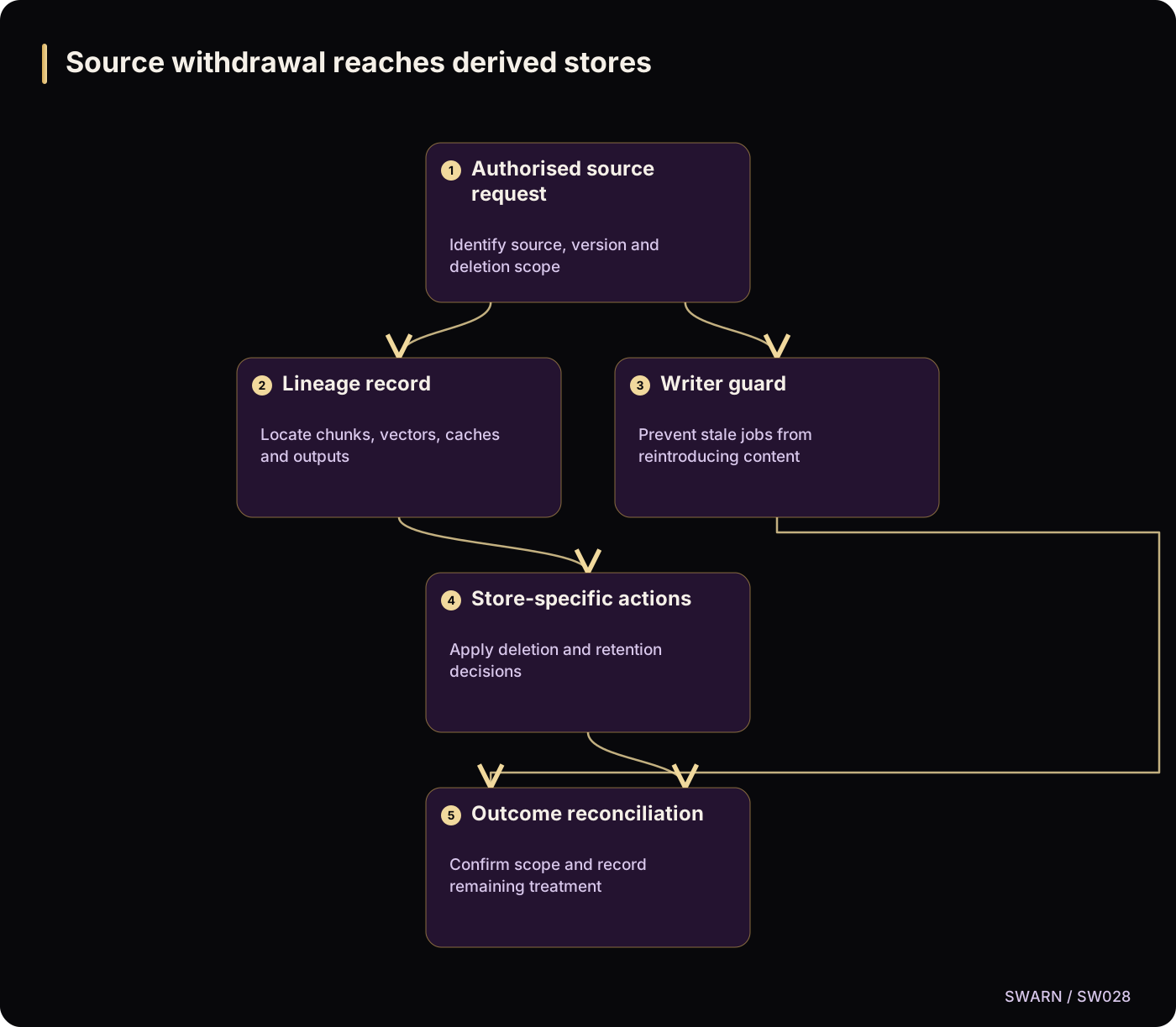
Source withdrawal reaches derived stores
Text version of the diagram
- Authorised source request: Identify source, version and deletion scope
- Lineage record: Locate chunks, vectors, caches and outputs
- Writer guard: Prevent stale jobs from reintroducing content
- Store-specific actions: Apply deletion and retention decisions
- Outcome reconciliation: Confirm scope and record remaining treatment
- Authorised source request → Lineage record
- Authorised source request → Writer guard
- Lineage record → Store-specific actions
- Writer guard → Outcome reconciliation
- Store-specific actions → Outcome reconciliation
Sources and reading context
These references support the original 22 October 2026 research. Source links and the date above make the scope of this article explicit.
- Delete data · Delete by ID, delete by metadata and data freshness
Supports product-specific deletion mechanisms and eventual-consistency verification
- OWASP LLM08:2025 Vector and Embedding Weaknesses · Vector-store security risks
Supports lifecycle controls over derived vector data