
Evaluation and quality · SW044
Evaluate a privacy pilot with outcomes you can reproduce
Make a privacy pilot reproducible with a fixed task, documented cases, versioned configuration and evidence for both successful and failed outcomes.
Research cutoff: . This dated explainer is general information; check the linked instruments and your circumstances before acting.
SWARN is in development. Product workflows described here are design and evaluation guidance; availability depends on the published product status and agreed scope.

A privacy pilot should leave another person able to repeat the important decisions. A polished demonstration can show that a workflow is possible; a reproducible evaluation shows what was tested, under which conditions and with which limitations.
The difference is preparation. Define the task, cases and acceptance criteria before the team starts selecting impressive outputs.
Choose one decision the pilot must support
A hypothetical business wants to know whether a proposed redaction workflow can prepare support messages for an internal quality-review team.
The decision is narrower than “Is this product compliant?” It concerns specific messages, recipients, entities, transformations and operating conditions. Write those boundaries into the pilot brief.
Choose a comparison that helps the decision. It might be the current manual process or an existing configuration. Apply the same relevant cases and scoring rules to each. If one process includes human review and another does not, make that difference explicit.
NIST’s Privacy Framework is voluntary risk-management guidance. It can help organise objectives and responsibilities, but using it does not certify the pilot or its outcome.
Preserve the ingredients
Record the fixture set, annotation guide, model and recogniser versions, thresholds, transformation rules and relevant application configuration. Include the extraction path and external services if they affect the result.
If a remote service cannot expose an exact internal model version, record the available service identifier, request date and relevant settings. Treat that limitation as part of reproducibility rather than inventing a version or claiming identical future behaviour.
Keep dataset and configuration versions linked to each run. A screenshot without this context is difficult to reproduce, especially after a provider or dependency changes.
Use approved fixtures. Synthetic data can make controlled tests easier, but it is not automatically a complete or private substitute for real-world data. NIST’s de-identification guidance discusses risks and limitations associated with synthetic data and release context.
Where fixture distribution differs from the intended workload, state the gap. A pilot made entirely of clean text cannot establish performance on noisy scanned documents.
Predefine what counts as success
For the redaction workflow, acceptance might depend on detection results, final-output inspection, reviewer usefulness and handling of unsupported input. The team should decide which conditions are mandatory and which remain exploratory.
Avoid inventing a single headline target after seeing the results. If a threshold changes during development, preserve the reason and rerun the development cases. Evaluate the chosen configuration on separate held-out material that has not guided the change. This preserves the separation between tuning and final evaluation described in scikit-learn’s data-leakage guidance.
Presidio’s evaluation guidance supports task-specific measurement. Record the matching rules and error counts so another reviewer can understand the result rather than relying on an unexplained score.
A pilot should also test failure behaviour. Include a detector timeout, an unreadable input and an uncertain entity case if those conditions are relevant. A safe and usable fallback may be as important as the successful path.
Measure operational performance honestly
If latency, throughput or review effort matters, define how it is measured. State the hardware or service route, input sizes, concurrency and whether setup or model loading is included.
Separate active processing time from queue delay and human waiting time. Report the observations actually collected. Do not turn a single fast demonstration into a service-level promise.
For cost, list the components included and excluded. A narrow API charge may omit storage, review labour or integration support. The pilot does not need a sophisticated financial model to be useful, but its scope should be visible.
Keep performance evidence separate from privacy acceptance. A fast result that exposes unnecessary content has not met the same objective as a slower, appropriately controlled result.
Produce a decision record
The pilot pack should contain the brief, versioned inputs, configuration, run results, representative errors and a clear deployment recommendation.
A second reviewer should be able to check:
- The evaluated task matches the proposed deployment.
- Important cases were not removed after they failed.
- Dataset origins and limitations are documented.
- Metrics and operational measurements can be recalculated.
- Failure and fallback paths were exercised.
- Unresolved issues have an owner and an acceptance consequence.
The recommendation may be to proceed within a narrow scope, repeat a specific test or stop until a missing control is addressed. All three can be useful pilot outcomes.
For SWARN, which is in development, this is an evaluation framework for proposed workflows. It does not imply that the described capabilities or results already exist. The evidence produced by a future pilot should determine the claim that can responsibly be made.
Reproducible pilot evidence supports a decision
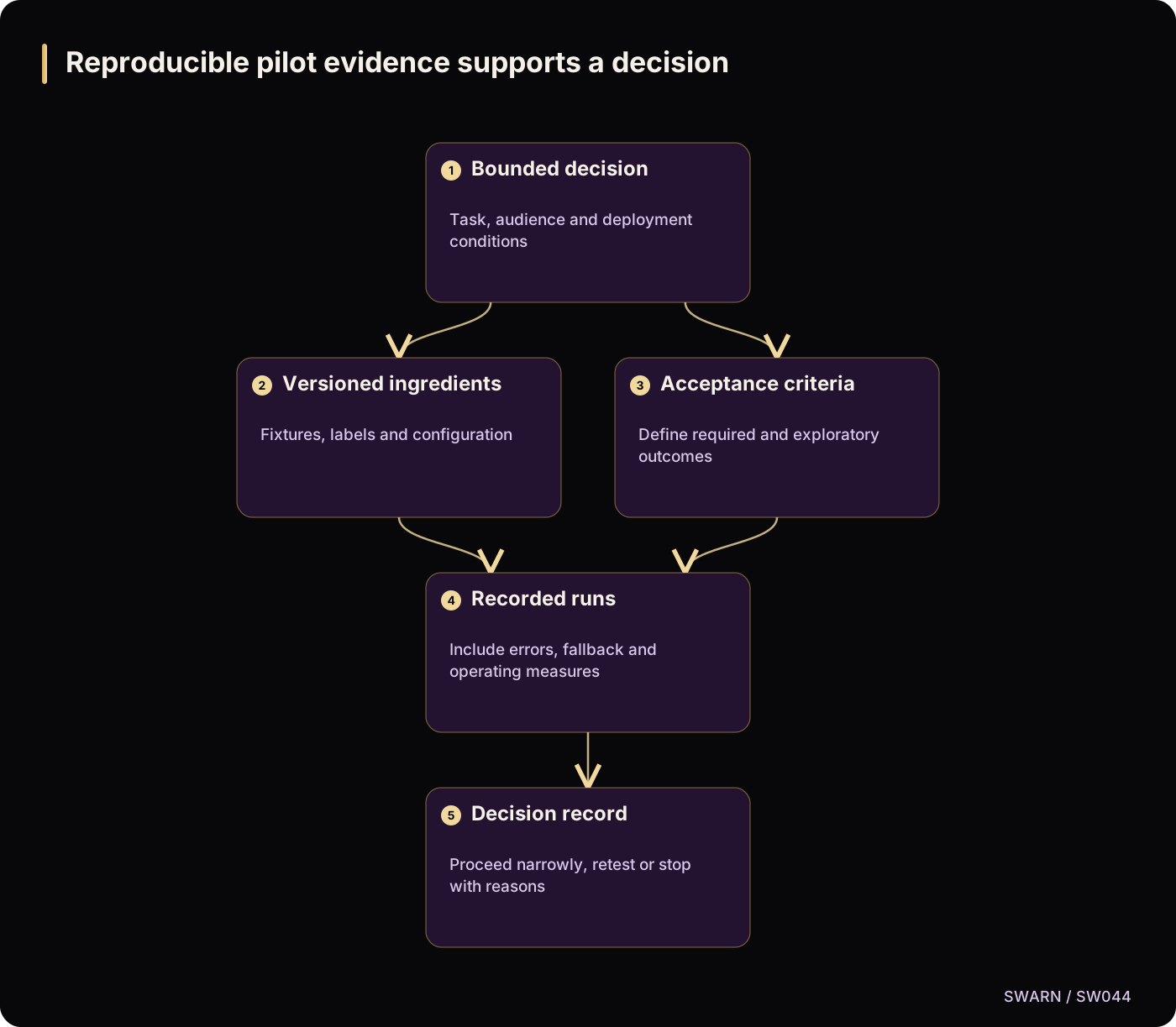
Text version of the diagram
- Bounded decision: Task, audience and deployment conditions
- Versioned ingredients: Fixtures, labels and configuration
- Acceptance criteria: Define required and exploratory outcomes
- Recorded runs: Include errors, fallback and operating measures
- Decision record: Proceed narrowly, retest or stop with reasons
- Bounded decision → Versioned ingredients
- Bounded decision → Acceptance criteria
- Versioned ingredients → Recorded runs
- Acceptance criteria → Recorded runs
- Recorded runs → Decision record
Sources and reading context
These references support the original 22 October 2026 research. Source links and the date above make the scope of this article explicit.
- NIST Privacy Framework · Privacy risk-management framework
Supports bounded use of voluntary framework guidance
- NIST SP 800-188: De-Identifying Government Datasets: Techniques and Governance · Synthetic data and release context
Supports fixture limitations and privacy assessment
- Evaluating PII detection with Presidio · Use-case evaluation
Supports explicit metrics, cases and matching rules
- Common pitfalls and recommended practices · Data leakage
Supports keeping final test data out of model and threshold choices