
Evidence and logs · SW032
Give privacy reviewers a trace they can understand
Give reviewers an understandable timeline of a privacy workflow, with resolved references, honest status and access to only the evidence they need.
Research cutoff: . This dated explainer is general information; check the linked instruments and your circumstances before acting.
SWARN is in development. Product workflows described here are design and evaluation guidance; availability depends on the published product status and agreed scope.

A reviewer should not need to read raw service logs to understand why a privacy request remains open. They need a coherent account: what was requested, what the team decided, which systems acted and what remains unresolved.
That account should be built from evidence, not reconstructed as a reassuring narrative after the event. A trace becomes useful when its references resolve, its status words have precise meanings and its gaps remain visible.
Start with the reviewer’s decision
Imagine a hypothetical reviewer checking whether a withdrawal reached the systems that send promotional messages. The question is specific: may the case be closed, or is a sending system still pending?
A useful trace would show the original instruction’s reference, the decision that accepted it, the downstream work created and each system’s acknowledgement. It might also show a delivery failure and a retry.
The reviewer does not automatically need the customer’s full profile or every message the person has sent. Give them enough context to assess the workflow and a controlled route to supporting material where necessary.
NIST’s privacy-engineering objectives include predictability and manageability. Applied here as design guidance, those ideas favour a system whose data handling and state changes can be understood and acted upon.
Define status words before designing the screen
“Received” means the service has captured an instruction. “Accepted” means the relevant validation or decision has succeeded. “Applied” means a target system reports the required change. “Verified” means the defined confirmation check has passed.
Your service may use different terms, but each should have a documented condition. Avoid a single “complete” label that can mean any of them.
For the withdrawal example, an outbound queue entry proves that work was scheduled. It does not prove that the sending platform changed its state. A successful HTTP response may confirm receipt while later processing remains pending. Use the integration’s actual contract to determine what it establishes.
Make partial completion visible. If two systems have applied the instruction and one has failed, the case should retain that distinction rather than collapsing to an ambiguous average.
Resolve references without widening access
A trace often contains event, case, subject, purpose and system identifiers. Reviewers need human-readable explanations of these relationships, but identifiers should not become unrestricted links to every underlying record.
Apply the same authorisation rules when resolving a reference as when opening the original record. OWASP’s authorisation guidance recommends checking permissions for every request. A privileged trace interface should not accidentally bypass those checks.
Show a meaningful label when a reviewer is entitled to it. Where detail is restricted, explain that restriction and the approved escalation route. A mysterious identifier without any interpretation creates unnecessary investigation work.
Preserve notice or configuration versions when they are relevant to the decision. A link to the latest version may tell the reviewer something different from what applied at the time.
Show uncertainty in the timeline
Distributed systems may report events at different times. Record the distinction between when an action occurred, when a system reported it and when the central service received that report where the workflow needs it.
Do not silently infer ordering from display position if timestamps or delivery order are uncertain. Group related events and explain known delays.
The trace should also reveal missing evidence. A system that has not acknowledged an instruction should remain pending or unresolved. An administrator’s manual closure should carry its reason and authorisation rather than erasing the gap.
OWASP’s logging guidance supports preserving useful event information and protecting it against unauthorised changes. The presentation layer should maintain that integrity while making the record easier to interpret.
Test with a person, not only a schema
Give a reviewer a synthetic case with one successful target, one delayed target and a correction to an earlier error. Ask them to decide whether closure is justified and explain their evidence.
Use the findings to check:
- Status labels correspond to documented conditions.
- Each important claim resolves to an event or controlled artefact.
- Pending work and missing evidence remain visible.
- References respect the reviewer’s permissions.
- The trace distinguishes original events from later corrections.
- Exported evidence remains understandable outside the live interface.
A trace that passes a JSON schema can still confuse its audience. The acceptance criterion is whether an authorised reviewer reaches a supportable decision without unnecessary access to personal data or informal help from the engineer who built the workflow.
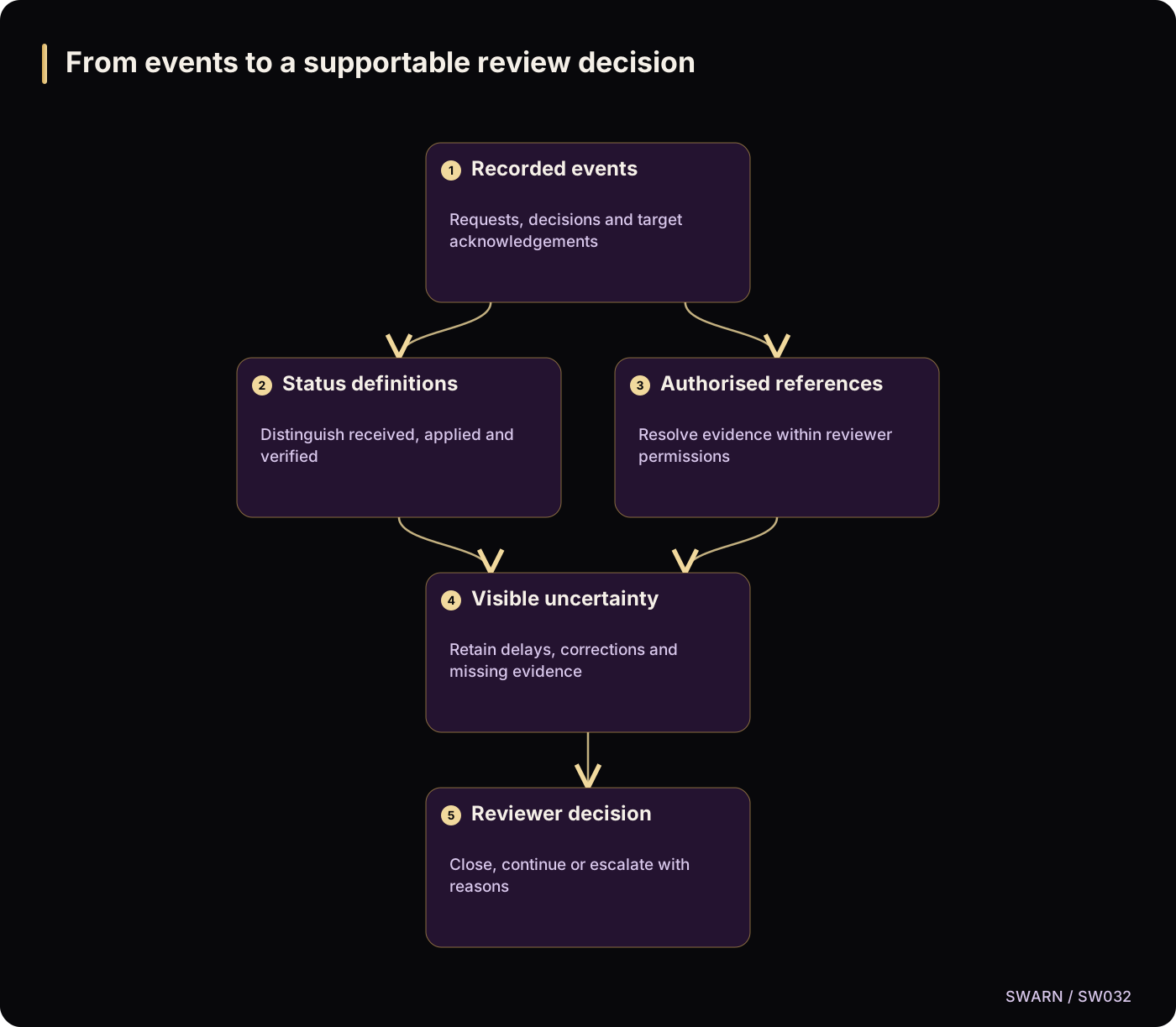
From events to a supportable review decision
Text version of the diagram
- Recorded events: Requests, decisions and target acknowledgements
- Status definitions: Distinguish received, applied and verified
- Authorised references: Resolve evidence within reviewer permissions
- Visible uncertainty: Retain delays, corrections and missing evidence
- Reviewer decision: Close, continue or escalate with reasons
- Recorded events → Status definitions
- Recorded events → Authorised references
- Status definitions → Visible uncertainty
- Authorised references → Visible uncertainty
- Visible uncertainty → Reviewer decision
Sources and reading context
These references support the original 22 October 2026 research. Source links and the date above make the scope of this article explicit.
- NIST IR 8062: An Introduction to Privacy Engineering and Risk Management in Federal Systems · Privacy-engineering objectives
Supports predictable and manageable processing as design goals
- Authorization Cheat Sheet · Permission validation
Supports controlled reference resolution
- OWASP Logging Cheat Sheet · Event protection and useful logging
Supports reliable evidence behind the review interface