
Deployment and security · SW037
Local processing changes the data path, not every privacy risk
Assess local processing by tracing every dependency and copy, including model downloads, telemetry, remote services and access on the host machine.
Research cutoff: . This dated explainer is general information; check the linked instruments and your circumstances before acting.
SWARN is in development. Product workflows described here are design and evaluation guidance; availability depends on the published product status and agreed scope.

Running a model on a local machine changes where inference happens. It does not, by itself, establish that the application sends no data elsewhere or that everyone with access to the machine should be able to see the input.
Local processing can be a useful design choice. Its privacy value depends on the surrounding system: extraction, storage, retrieval, diagnostics, updates, backups and administration. Review those paths with the same care as the model call.
Separate provisioning from processing
A system may download model files during installation and then run inference without contacting the model repository. Those are different phases with different network requirements.
Hugging Face’s installation documentation describes using cached files and offline configuration to avoid Hub access during relevant loading operations. That is a bounded capability of the documented tooling, not proof that every dependency in an application is offline.
For a hypothetical document assistant, record which components need network access during setup, update and routine use. Test the intended routine-use configuration after the necessary assets are present. A successful offline demonstration on one machine should not hide an automatic download path that another installation will trigger.
Keep model and dependency updates under an explicit process. Local deployment still requires decisions about software provenance, access and maintenance.
Find services outside the model runtime
The assistant might run inference locally while sending scans to a remote OCR service. It might use a remote embedding endpoint, store documents in a synchronised folder or forward diagnostic events to a cloud platform.
Map these separately. A local model cannot protect a document that an earlier stage already transmitted.
Ollama’s FAQ distinguishes local operation from cloud functionality and documents configuration choices. When using such a runtime, verify the actual model route and settings. The presence of a local endpoint is not sufficient evidence about every application request.
Include browser components, plugins and background workers in the inventory. The visible interface may connect to a local service while an extension or supporting API uses a different destination.
Check who can reach the local service
Local storage and inference still need access controls. A shared workstation, a broadly exposed service port or an unrestricted application account can make data available to people who should not receive it.
Define the users and processes permitted to submit input, inspect results and administer the runtime. Review how the service binds to network interfaces and how the surrounding application authenticates callers.
Do not treat the host boundary as a substitute for tenant or document permissions. If a local server serves several teams, each request still needs the appropriate scope.
The same applies to temporary files. Extracted text, cached prompts and generated outputs may remain readable after a user closes the interface. Their lifecycle is part of the deployment design.
Test the claim you intend to make
The document assistant’s proposed claim might be: “During this configured workflow, document content is processed on the approved host and is not transmitted to external inference or extraction services.”
That statement has a scope and can be tested. It still says nothing by itself about backups, administrator access or every possible optional integration.
Use synthetic markers and approved network-observation methods to inspect the configured workflow. Exercise normal processing, an error, a restart and a missing-model condition. Review destination logs or controls where available.
A lack of observed traffic in a small test is evidence about that test, not mathematical proof of all future behaviour. Pair observation with configuration review and enforced network policy appropriate to the environment.
Give telemetry its own decision
Diagnostic systems can undo an otherwise local data path if they export prompts or document content. OpenTelemetry’s sensitive-data guidance supports minimising collection and controlling transformations.
Prefer operational fields that explain performance without copying the input. Inspect crash reports, support bundles and debug settings as well as ordinary traces.
Before accepting the deployment, document:
- The boundary between setup, updates and routine processing.
- Every remote service used by the complete workflow.
- Who can access the host, service endpoint and stored outputs.
- Temporary-file, cache and backup treatment.
- Telemetry content and destinations.
- The exact configuration and cases covered by the network check.
Local processing is an architectural property with practical benefits and operational responsibilities. Describe those properties precisely, and keep claims about anonymity, compliance or complete isolation dependent on separate evidence.
Local inference inside a wider data path
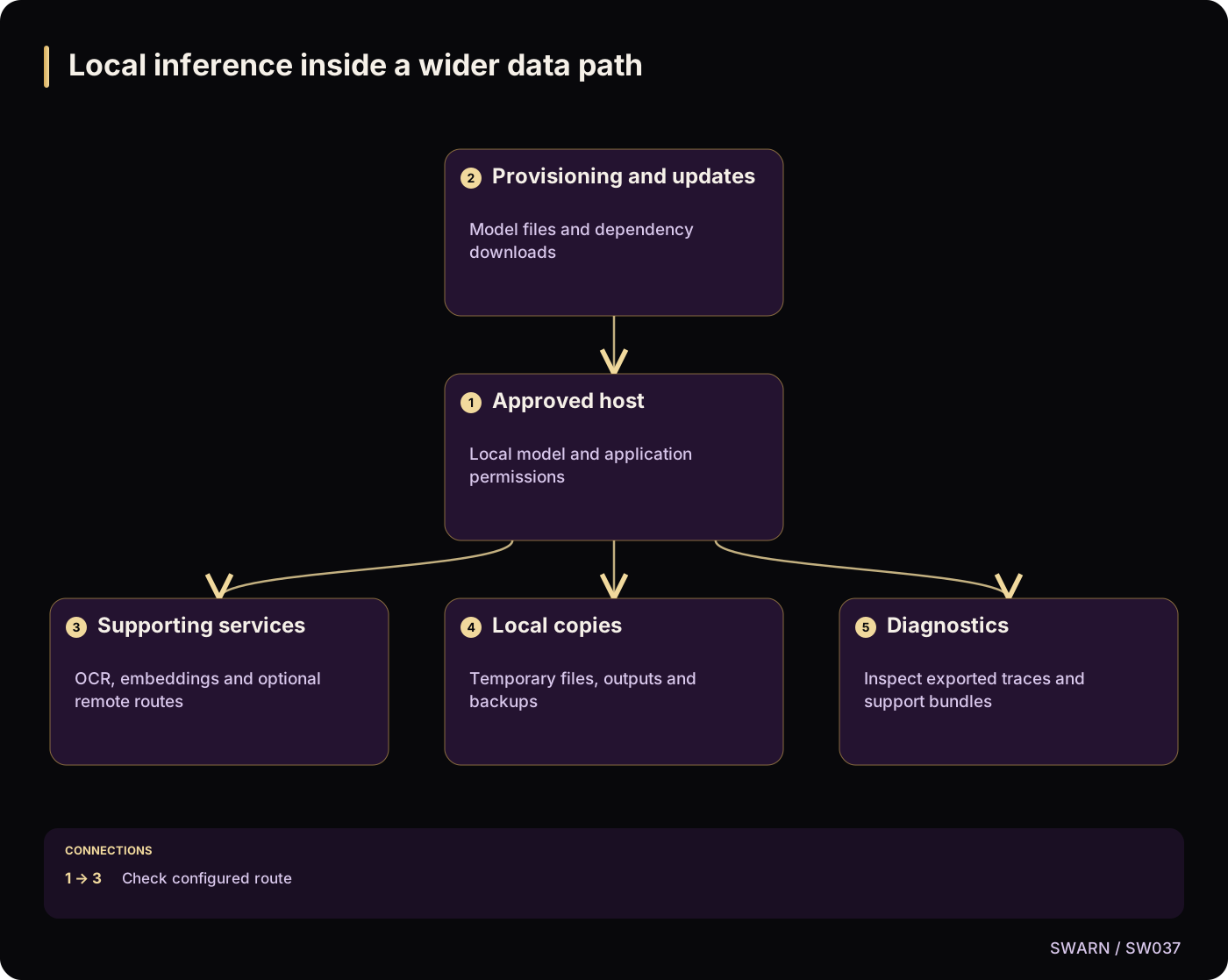
Text version of the diagram
- Approved host: Local model and application permissions
- Provisioning and updates: Model files and dependency downloads
- Supporting services: OCR, embeddings and optional remote routes
- Local copies: Temporary files, outputs and backups
- Diagnostics: Inspect exported traces and support bundles
- Provisioning and updates → Approved host
- Approved host → Supporting services: Check configured route
- Approved host → Local copies
- Approved host → Diagnostics
Sources and reading context
These references support the original 22 October 2026 research. Source links and the date above make the scope of this article explicit.
- Transformers installation: offline mode · Offline and cached operation
Supports a bounded description of offline model loading
- Ollama FAQ: local and cloud operation · Local and cloud operation
Supports checking runtime routes and configuration
- Handling sensitive data · Telemetry minimisation
Supports reviewing diagnostic content separately