
Employment and service sectors · DP075
Privacy in clinics starts at the reception desk
Reduce avoidable exposure around clinic registration, appointment messages, document handling and reception access.
Research cutoff: . This dated explainer is general information; check the linked instruments and your circumstances before acting.
At clinic reception, privacy often depends on ordinary choices: where a form is placed, what appears on a monitor, which phone receives a reminder and whether a staff member forwards a complete report to answer a scheduling question. Improving those choices does not require reception staff to make clinical decisions.
Begin by separating the appointment task from the clinical record. Staff should have the information needed for their role, with a clear route to the appropriate professional when more detail is genuinely required.
Review what reception collects
List the fields requested at booking and arrival. Identify why each is needed at that stage and whether the same purpose can be met with less detail. Avoid placing broad medical-history questions in a general enquiry form simply because the software offers them.
As of 22 October 2026, the relevant substantive DPDP duties are scheduled for 13 May 2027 under the commencement notification. The future scope in section 3 includes digital personal data and information collected offline that is later digitised. Sensible confidentiality around spoken and paper interactions remains important even where that particular digital-scope provision is not the answer to every situation.
Existing obligations, including the SPDI framework where applicable and relevant professional or sector requirements, require separate assessment during the transition. This article addresses reception operations; it does not prescribe clinical recordkeeping periods or decide every healthcare processing basis.
Give each role an appropriate view
Reception may need appointment times, a contact route and a limited operational note. A treating professional may need a fuller clinical history. A billing task may need another defined set of information. Configure access around those tasks where the system permits it.
The future section 8(5) and rule 6 framework will address safeguards, including access controls. As preparation, check whether a receptionist can open unrelated patient records, whether a shared account obscures individual access and whether former staff remain authorised.
Also review the physical workspace. Turn screens away from public view where practical, keep completed forms out of an open stack and avoid announcing unnecessary personal detail across a waiting area. These are operational precautions, not a claim that the DPDP Rules prescribe a particular reception-desk layout.
A hypothetical appointment correction
A patient asks the clinic to change the phone number used for reminders. Reception updates the scheduling system but notices that a separate messaging service still holds the old number. The staff member follows a defined correction route, confirms the appropriate destination and checks the next scheduled message.
The reminder contains only the information needed for the appointment and the agreed contact process. It does not include a detailed diagnosis merely because that field is available in the record. If the phone is shared, the team uses the person’s suitable communication arrangement rather than assuming that every message can be equally explicit.
This example also illustrates the future section 8(3) accuracy requirement in its specified decision and disclosure contexts. A correction needs to reach the systems that use the relevant detail, not stop at the first screen edited.
Handle documents through a controlled route
If a patient provides a report or identity document, identify the approved destination and the person who needs it. Avoid forwarding the full file to a broad staff group to answer a narrow administrative question. Where a document is misdirected, staff need an escalation route that contains the exposure and brings it into the correct process.
Check temporary downloads, scanner folders and print queues as well as the main clinical system. A secure application can coexist with an open shared folder containing every scanned document. Assign an owner to those working locations and include them in the applicable retention process.
Include service providers in the assessment
Booking, messaging, billing and storage services may each process information. Understand what each receives, why, and which party decides any additional uses. The future section 8(1) accountability provision will remain relevant where processing is performed on the clinic’s behalf.
Ask providers for evidence tied to the deployed service rather than relying on a broad compliance slogan. Test account removal and a synthetic appointment correction before relying on the workflow.
The recurring failure is treating reception as merely administrative and therefore outside privacy planning. A clear division of tasks, discreet communication and controlled document handling can reduce avoidable exposure while helping staff complete the appointment work accurately.
Keep reception focused on the appointment task
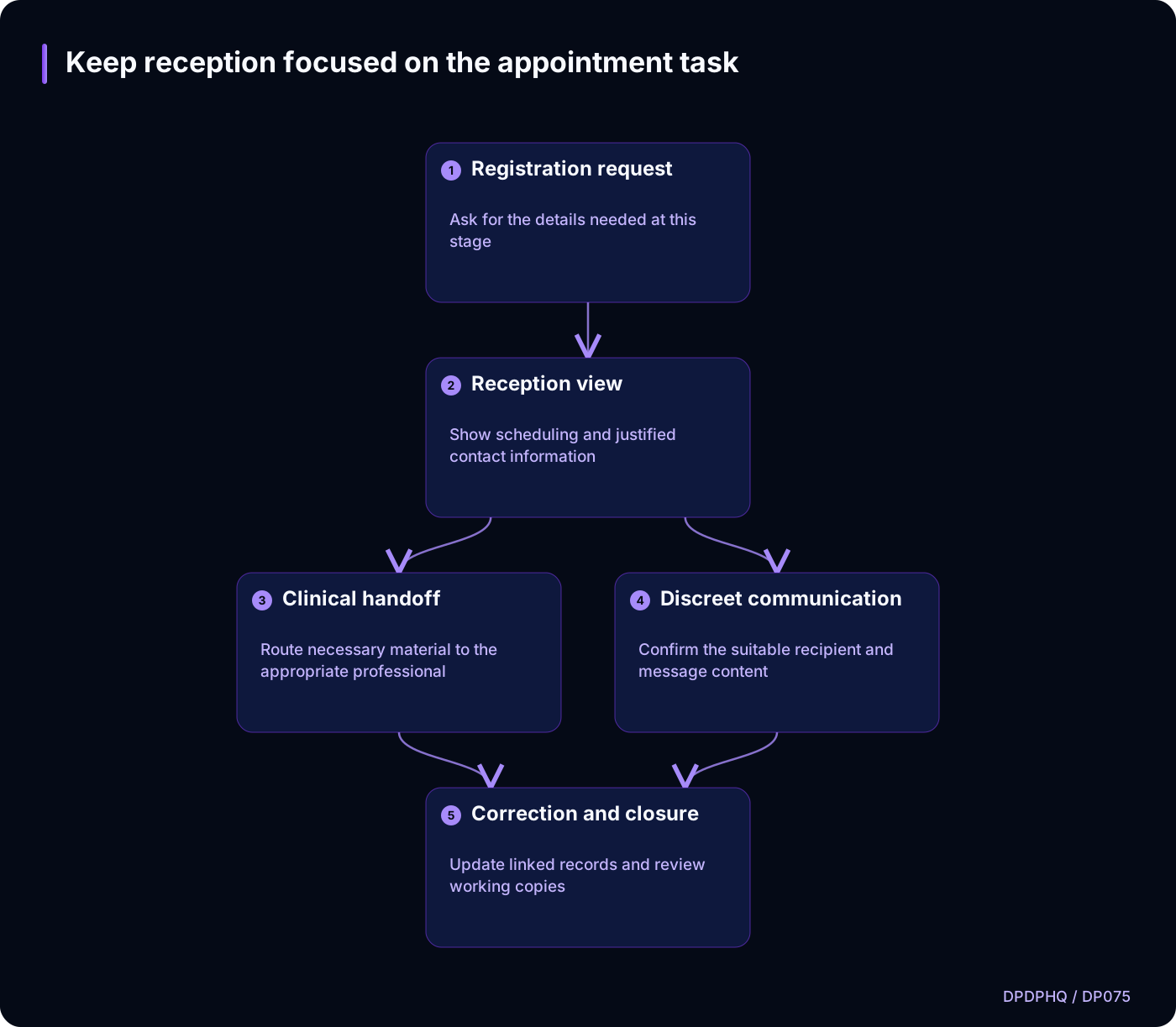
Text version of the diagram
- Registration request: Ask for the details needed at this stage
- Reception view: Show scheduling and justified contact information
- Clinical handoff: Route necessary material to the appropriate professional
- Discreet communication: Confirm the suitable recipient and message content
- Correction and closure: Update linked records and review working copies
- Registration request → Reception view
- Reception view → Clinical handoff
- Reception view → Discreet communication
- Clinical handoff → Correction and closure
- Discreet communication → Correction and closure
Sources and reading context
These references support the original 22 October 2026 research. Source links and the date above make the scope of this article explicit.
- Commencement notification for provisions of the DPDP Act · paragraph (c)
Dates the future DPDP duties
- Digital Personal Data Protection Act, 2023 · sections 3, 8(1), 8(3), 8(5)
Digital scope, accountability, accuracy and safeguards
- Digital Personal Data Protection Rules, 2025 · rule 6
Future safeguards
- Information Technology (Reasonable security practices and procedures and sensitive personal data or information) Rules, 2011 · applicable collection and security provisions
Acknowledges existing obligations where applicable