
Evaluation and quality · SW043
Build a regression set for multilingual privacy workflows
Build a versioned regression set that preserves multilingual failures, separates related templates and checks the complete privacy workflow after changes.
Research cutoff: . This dated explainer is general information; check the linked instruments and your circumstances before acting.
SWARN is in development. Product workflows described here are design and evaluation guidance; availability depends on the published product status and agreed scope.

A multilingual privacy workflow can improve on one group of cases while becoming worse on another. A new model, OCR setting, normalisation rule or recogniser threshold may change behaviour even when the user interface looks identical.
A regression set gives those changes something concrete to answer to. It preserves meaningful cases, expected outcomes and the reasons those outcomes matter. The set should evolve deliberately rather than becoming a folder of unexplained examples.
Organise cases around failure mechanisms
A hypothetical support service handles English, Romanised Hindi, Devanagari and mixed messages. Its test set should not consist of four folders labelled only by language.
Add the dimensions that affect the workflow: script, code-switching pattern, entity category, document channel, extraction path and expected action. A Devanagari image and digital Devanagari text exercise different components. A Hindi name recogniser and an Indian identifier pattern also provide different coverage.
Presidio’s language documentation explains that language support requires appropriate NLP and recogniser configuration. GLUECoS provides primary research on code-switching evaluation. Neither source establishes performance for this hypothetical service; they help explain why coverage needs more detail than a language badge.
Give every case a small record
Store the fixture, its approved origin, the expected entity spans, expected transformation or routing outcome and the reason the case exists. Include a stable case identifier and relevant configuration requirements.
For a case created after an observed failure, describe the failure mechanism without copying unnecessary customer content. Prefer a carefully constructed synthetic reproduction where it preserves the behaviour being tested.
Record who reviewed the expected result and any unresolved annotation ambiguity. A regression test with an uncertain label can create false confidence or block a legitimate improvement.
If a fixture depends on an OCR image, keep the source image and expected text or regions together. A text-only substitute cannot reproduce every extraction failure.
Keep development and evaluation roles separate
Developers need cases they can inspect and use to fix problems. The final evaluation also needs cases that have not been repeatedly used to tune the system.
Group related templates and paraphrase families when splitting the dataset. Changing a name inside the same sentence template does not necessarily create an independent test of generalisation.
Presidio’s evaluation material discusses synthetic datasets and evaluation design. Use synthetic cases to probe known boundaries, while documenting where their regularity may make them easier than naturally occurring input.
A fixed regression suite and a held-out evaluation set serve related but different purposes. Passing known cases shows that specific behaviour remains intact. It does not establish performance on all unfamiliar messages.
Run the whole path when the change affects it
A detector-only test is appropriate for a narrow recogniser change, but a workflow update may also affect text offsets, routing, replacement or export.
For the support service, a normalisation change should be checked against the original representation and final output. An OCR update should include extraction cases. A logging change should be checked for unnecessary payload capture.
Use a coverage map linking each component change to the cases it must exercise. This makes testing purposeful without rerunning unrelated expensive checks for every minor edit.
Tesseract’s quality guidance identifies extraction factors such as skew and segmentation. Where OCR is in scope, preserve fixtures that exercise the relevant conditions.
Review differences rather than only totals
The regression report should identify cases that changed, the expected and actual outcomes and the affected categories. A stable overall score can hide a new serious miss offset by several harmless improvements.
Require a reason for changing an expected result. If the entity policy changes, version the policy and document the decision. Do not rewrite a failing label merely to make the test pass.
Before adopting the suite, check:
- Cases cover relevant language, script and workflow combinations.
- Fixture origins and expected outcomes are reviewable.
- Related templates remain grouped in dataset splits.
- Known regression cases are distinguished from held-out evaluation.
- Changes to extraction, spans and rendering receive appropriate checks.
- Newly observed errors have a controlled route into the set.
The lasting asset is an understandable record of what the team has learned. It allows later engineers to preserve useful behaviour, revisit assumptions and explain why a release is supported by more than a single aggregate score.
Maintain a multilingual regression learning loop
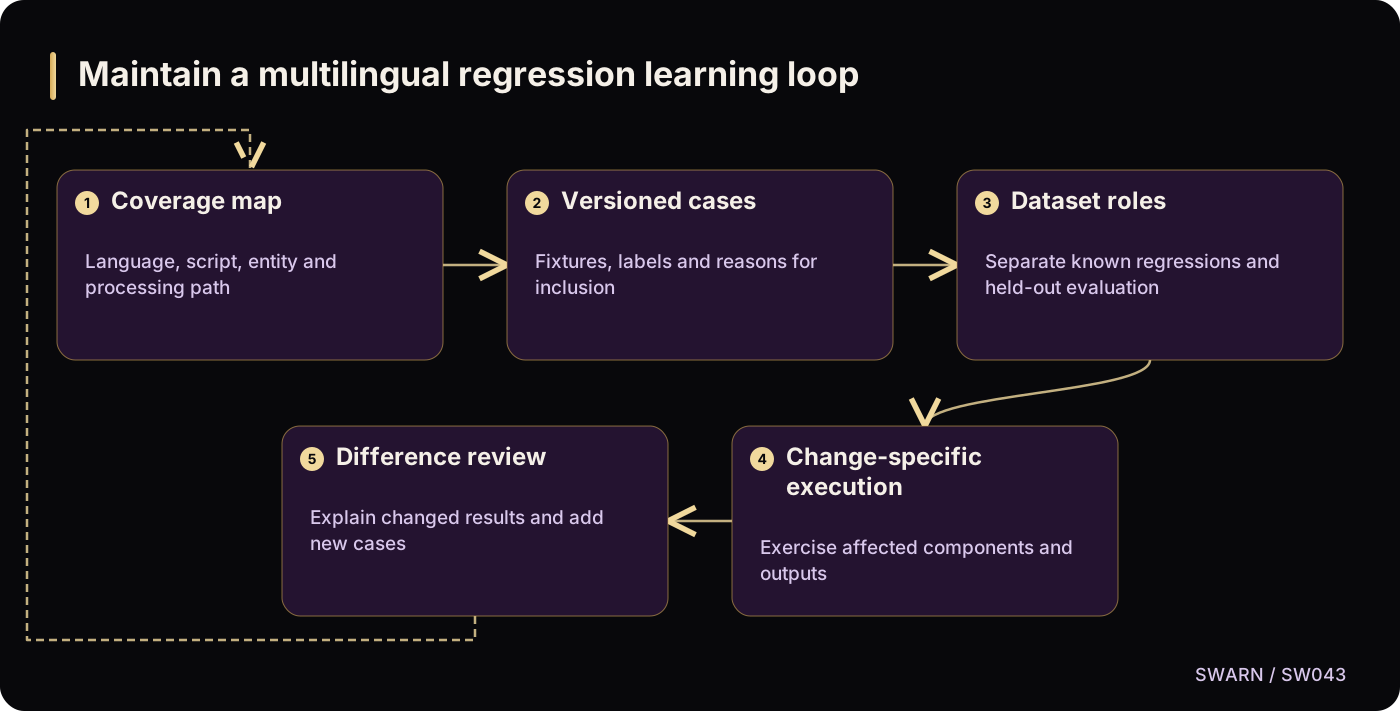
Text version of the diagram
- Coverage map: Language, script, entity and processing path
- Versioned cases: Fixtures, labels and reasons for inclusion
- Dataset roles: Separate known regressions and held-out evaluation
- Change-specific execution: Exercise affected components and outputs
- Difference review: Explain changed results and add new cases
- Coverage map → Versioned cases
- Versioned cases → Dataset roles
- Dataset roles → Change-specific execution
- Change-specific execution → Difference review
- Difference review → Coverage map
Sources and reading context
These references support the original 22 October 2026 research. Source links and the date above make the scope of this article explicit.
- PII detection in different languages · Language configuration
Supports separating language support from recogniser coverage
- GLUECoS: An Evaluation Benchmark for Code-Switched NLP · Code-switching benchmark scope
Supports explicit mixed-language evaluation
- Evaluating PII detection with Presidio · Evaluation and synthetic data
Supports dataset splitting and use-case measurement
- Improving the quality of the output · OCR quality factors
Supports extraction-specific regression cases