
Pilot adoption · SW045
Choose a first privacy pilot small enough to finish
Choose a first privacy pilot with one observable outcome, a named owner and a manageable system boundary, so the result can support a clear decision.
Research cutoff: . This dated explainer is general information; check the linked instruments and your circumstances before acting.
SWARN is in development. Product workflows described here are design and evaluation guidance; availability depends on the published product status and agreed scope.

A first privacy pilot should end with a decision someone can make. “Explore privacy automation across the business” is too broad to supply that decision. “Establish whether withdrawal instructions reach this messaging system through this workflow” is specific enough to test.
Small scope does not mean an easy demonstration with no difficult cases. It means a bounded workflow whose inputs, owners, dependencies and outcomes the team can understand and control.
Choose an outcome with a visible finish
A hypothetical retailer considers three possible pilots: mapping every customer-data store, redesigning all consent screens or connecting one withdrawal route to one campaign platform.
The third option may be a useful first candidate if the team can establish the current process and obtain the necessary access. Its finish is observable: a valid instruction is captured, applied to the relevant sending control and supported by evidence.
That does not make it universally preferable. If the retailer cannot identify the authoritative customer record, an identity-matching or inventory task may need to come first.
NIST’s Privacy Framework provides voluntary guidance for understanding and managing privacy risk. Use it to connect the pilot to a real organisational objective rather than selecting a feature solely because it is easy to demonstrate.
Check that the boundary is manageable
List the people and systems required to complete the proposed outcome. Include external providers, manual handoffs and reporting access. A pilot is not small if its apparent single screen depends on unresolved changes across several teams.
Ask whether the team can create approved test records, observe the relevant states and safely recover from a mistake. If those capabilities are missing, the first deliverable may be access or instrumentation rather than automation.
Name what is outside scope. For the withdrawal example, the pilot might cover one promotional channel and exclude other communication purposes. That exclusion needs to remain visible in the result and any later demonstration.
Avoid treating the first pilot’s boundary as the permanent architecture. It is a controlled learning scope.
Give one person authority to resolve trade-offs
A pilot owner needs more than responsibility for scheduling meetings. They must be able to obtain decisions about the workflow, bring the relevant system owners together and record acceptance or rejection of the result.
Separate operational ownership from technical implementation where that helps. The engineer can explain a failed acknowledgement; the business owner decides whether to close the pilot with an explicit unresolved finding or require further work. Closing the pilot does not itself complete a customer’s outstanding instruction.
Identify who will handle exceptions during the pilot. If a real instruction arrives through the test route, staff need to know how it enters the approved operational process.
For SWARN, which is in development, this is guidance for selecting a future pilot. It does not assert that any specific integration or workflow is currently available.
Agree the evidence before building
Write a short acceptance sheet covering the normal path, a duplicate submission, an ambiguous match, a downstream failure and recovery. Choose the cases relevant to the actual workflow rather than collecting an impressive number of generic tests.
Define what each result must show. A successful queue entry is not equivalent to a changed sending preference. A screenshot of a green status is useful only when the status has an agreed meaning.
NIST’s privacy-engineering objectives include predictability and manageability. Applied to this pilot, the team should be able to explain the system’s behaviour and control pending or incorrect processing.
Decide what would stop the pilot. Examples include unresolved identity matching, inability to observe downstream state or an unsupported data path. A stop condition prevents schedule pressure from converting missing evidence into an assumption.
Keep the effort visible
Estimate the work in concrete activities: configuring access, preparing fixtures, changing the workflow, training operators, running cases and reviewing results. Record dependencies that the pilot team cannot control.
Do not promise a completion date based only on implementation time. The review and operational handover are part of finishing.
At the decision meeting, ask:
- Did the selected outcome occur under the stated conditions?
- Can another authorised person inspect the evidence?
- Were important failures and recovery paths exercised?
- Is the operating owner prepared to maintain the workflow?
- Which exclusions remain material to wider deployment?
- Should the next step be expansion, revision or closure?
A first pilot has succeeded as a learning exercise when those questions have supportable answers. The next investment should follow the evidence from that bounded workflow, rather than the enthusiasm generated by a demonstration.
Select a pilot that can reach a decision
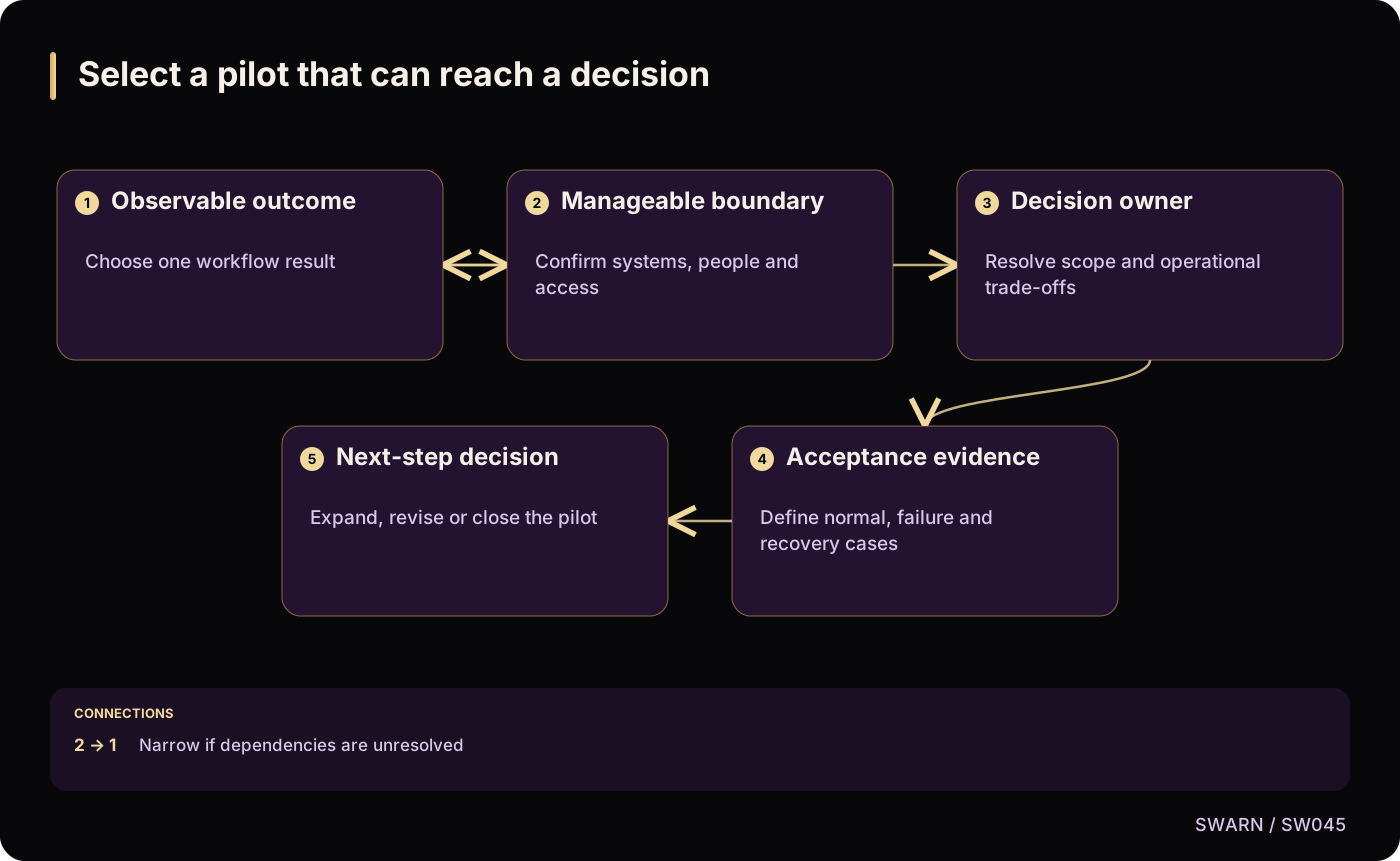
Text version of the diagram
- Observable outcome: Choose one workflow result
- Manageable boundary: Confirm systems, people and access
- Decision owner: Resolve scope and operational trade-offs
- Acceptance evidence: Define normal, failure and recovery cases
- Next-step decision: Expand, revise or close the pilot
- Observable outcome → Manageable boundary
- Manageable boundary → Decision owner
- Decision owner → Acceptance evidence
- Acceptance evidence → Next-step decision
- Manageable boundary → Observable outcome: Narrow if dependencies are unresolved
Sources and reading context
These references support the original 22 October 2026 research. Source links and the date above make the scope of this article explicit.
- NIST Privacy Framework · Organisational privacy risk management
Supports connecting the pilot to a defined objective
- NIST IR 8062: An Introduction to Privacy Engineering and Risk Management in Federal Systems · Predictability and manageability
Supports observable behaviour and control as pilot criteria