
Redaction engineering · SW022
Choose a redaction strategy that preserves useful context
Preserve the information a recipient needs while removing identifying detail, using task-specific replacements and review of the complete output.
Research cutoff: . This dated explainer is general information; check the linked instruments and your circumstances before acting.
SWARN is in development. Product workflows described here are design and evaluation guidance; availability depends on the published product status and agreed scope.

A redacted message should still let its recipient do the permitted job. If the recipient must understand why a parcel was delayed, removing every date and place may destroy the explanation. Leaving a precise home address simply because it adds context creates a different problem.
The design task is to specify useful context before choosing replacements. A transformation should be assessed against both the information it protects and the work its output is meant to support.
Write an output contract
An output contract describes the permitted audience, task and content. For a hypothetical complaint-quality review, it might allow the sequence of events, product category and broad delivery region, while excluding customer names, contact details and precise addresses.
This is more actionable than “remove PII”. It tells engineers what to preserve, gives reviewers a basis for disagreement and makes it possible to recognise a failed transformation.
NIST’s de-identification guidance considers the relationship between disclosure risk, data usefulness and the sharing model. Its approach supports assessing the release context. It does not supply a universal replacement rule for every customer message.
Match replacement detail to the task
A single marker such as “[REDACTED]” is simple, but repeated markers can obscure who did what. Category markers such as “[CUSTOMER]” and “[AGENT]” may preserve a conversation’s roles without exposing names.
Stable tokens can preserve relationships across a passage. If a message describes two people, distinct tokens can make the account intelligible. However, token reuse across a large collection can enable linkage. Decide whether consistency is needed within one message, one case or a wider dataset, and limit it accordingly.
Generalisation is another option. A workflow may need a delivery region without the street address, or an event’s order without an exact timestamp. Generalisation should follow explicit rules. Improvised substitutions can change the meaning or leave rare combinations identifying.
Presidio’s anonymiser documentation describes configurable transformation operators. A library can apply an operation, but the application still needs to decide which operator and scope serve the output contract.
Compare alternatives on the same example
Imagine a synthetic complaint about a failed delivery to a particular household followed by a successful collection from a depot. The quality reviewer needs to know that the delivery instruction was misunderstood and the customer had to travel.
Removing the entire location narrative would hide the service problem. Retaining a precise house description would disclose more than the review needs. A better candidate might preserve “home delivery” and “depot collection”, alongside the order of events.
Test that candidate with someone performing the actual review task. Can they identify the failure and recommend an operational fix? Separately, ask whether the output contains unnecessary identifying clues. These are two different questions and should have separate findings.
Do not present this hypothetical result as proof that generalisation is always sufficient. An unusual event or relationship can remain identifying even after direct identifiers have been replaced.
Review the whole transformed record
A detector operates on spans, but a person reads a record. Several harmless-looking fragments may become identifying together. Repeated references in a subject line, attachment name or quoted email can also defeat a transformation applied only to the main body.
Define the complete output boundary. For a support export, that might include the subject, message body, selected metadata and attachments. Check each included surface and its combination with the rest.
Where the pipeline changes text, verify that entity offsets still refer to the intended representation. Where a replacement map is retained, treat its access and lifecycle as a separate control.
An “anonymised” file label should not substitute for this review. NIST’s guidance explains that removing direct identifiers alone does not settle re-identification risk.
Establish a useful acceptance decision
A small redaction pilot can compare several strategies on the same held-out cases. Record the information required for the task, the unnecessary information remaining, any changed meaning and the amount of human correction needed.
Before adopting a strategy, answer:
- Does the recipient still have enough information to complete the approved task?
- Are replacement scopes and token consistency deliberately limited?
- Are indirect clues and repeated references included in the review?
- Does the final export contain only the fields the output contract permits?
- Is there a defined route for cases that cannot be transformed safely?
Some records may need individual review or may be unsuitable for the intended sharing arrangement. A sound strategy makes that boundary visible. Its success is a usable, appropriately limited output, supported by examples that another reviewer can inspect.
Evaluate protection and usefulness separately
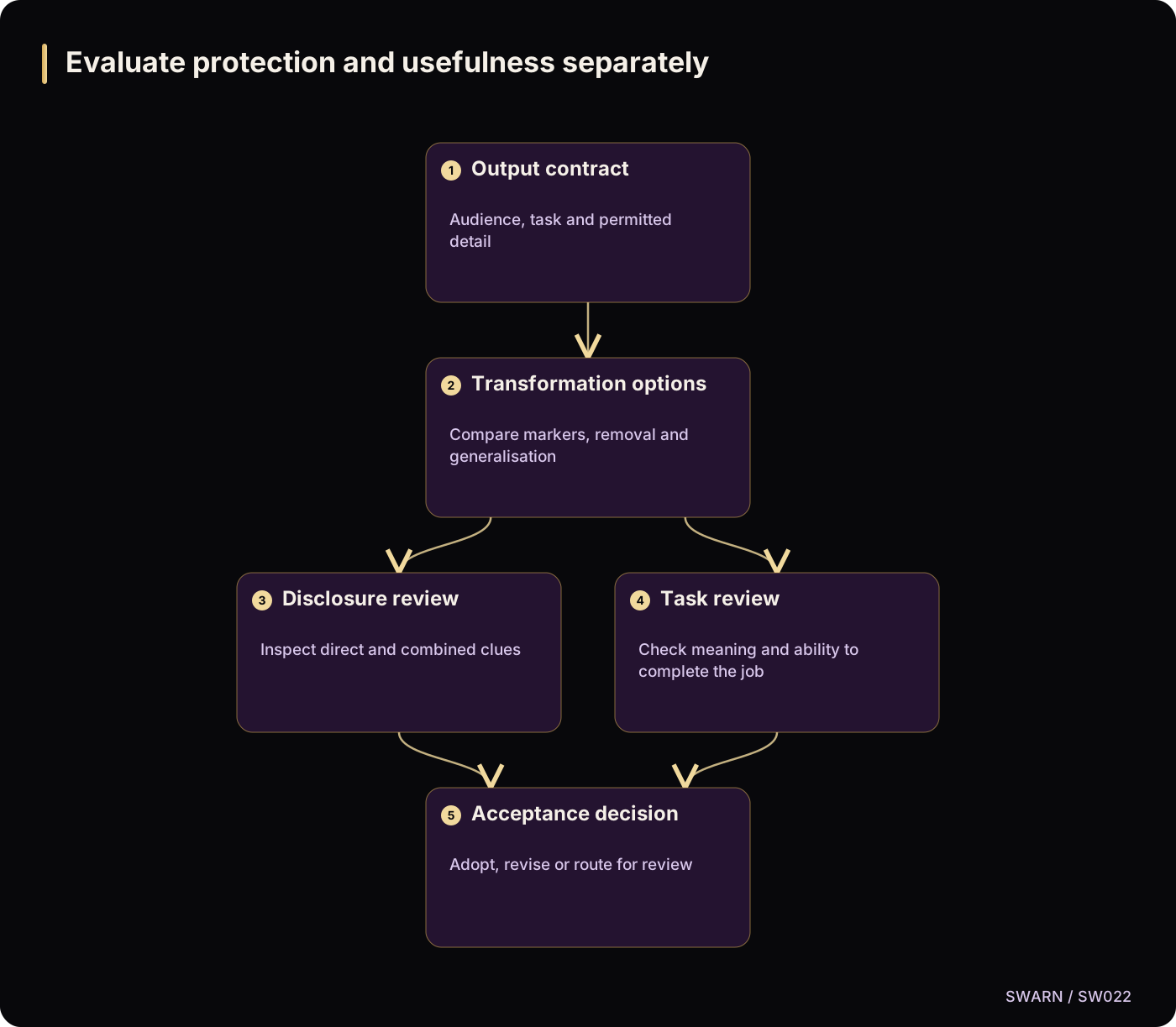
Text version of the diagram
- Output contract: Audience, task and permitted detail
- Transformation options: Compare markers, removal and generalisation
- Disclosure review: Inspect direct and combined clues
- Task review: Check meaning and ability to complete the job
- Acceptance decision: Adopt, revise or route for review
- Output contract → Transformation options
- Transformation options → Disclosure review
- Transformation options → Task review
- Disclosure review → Acceptance decision
- Task review → Acceptance decision
Sources and reading context
These references support the original 22 October 2026 research. Source links and the date above make the scope of this article explicit.
- NIST SP 800-188: De-Identifying Government Datasets: Techniques and Governance · Disclosure risk, usefulness and release models
Supports context-sensitive assessment and residual identification risk
- Presidio Anonymizer · Transformation operators
Supports choosing among configurable replacement and removal operations