
Product claims and buying decisions · SW049
How to read a privacy product roadmap without mistaking it for a feature list
Read a privacy product roadmap by separating planned work, prototypes, tested capabilities and production commitments, then ask for evidence at each stage.
Research cutoff: . This dated explainer is general information; check the linked instruments and your circumstances before acting.
SWARN is in development. Product workflows described here are design and evaluation guidance; availability depends on the published product status and agreed scope.

A roadmap describes intended direction. It does not establish that a feature exists, works in your environment or is supported for production use.
This distinction is especially important for privacy software, where a plausible screen can imply a much larger operating capability. A deletion button may sit above unfinished integrations. A detector label may conceal untested languages. A consent dashboard may show sample events rather than a live workflow.
SWARN is in development. The ideas discussed in this publication are design and evaluation guidance unless a specific capability is separately supported by current product evidence.
Ask what each status means
Roadmap labels are useful only when their definitions are clear. “Planned”, “prototype”, “pilot” and “available” should describe different evidence states.
A planned capability may have a problem statement and proposed design. A prototype may demonstrate an interaction using mocks. A pilot may have results under a limited set of conditions. A production capability needs operating boundaries, support and evidence appropriate to its use.
Ask the team to define these terms for its own roadmap. Do not infer maturity from the colour of a card or the presence of a demonstration link.
A target date is also different from a commitment. Dependencies, acceptance criteria and the consequences of a missed date should be explicit before a buyer relies on it.
Follow one feature below the surface
Consider a hypothetical roadmap item called “multilingual document redaction”. A reviewer should ask which languages and scripts are in scope, which document types are accepted, whether OCR is included and what happens when extraction fails.
Presidio’s language documentation shows that language support involves configuration and appropriate recognisers. Its evaluation guidance supports use-case-specific measurement. These sources illustrate why a broad feature label requires detailed evidence; they do not establish any SWARN capability.
The roadmap item may reasonably remain in development until its test conditions and fallback behaviour are known. That is a useful status, provided it is communicated accurately.
The same method applies to an integration. Ask whether the demo uses a mock, sandbox or live service, and which actions and permissions have been tested.
Separate product evidence from legal conclusions
A working privacy workflow can support an organisation’s obligations. It does not decide every question about legal scope, purpose, notice, retention or organisational responsibility.
NIST’s Privacy Framework is a voluntary risk-management resource. Using a framework or mapping features to its categories does not create a product certification.
Similarly, a security assessment has a scope, date and method. Ask what it examined and what it excluded. A test of one deployment should not be stretched into a guarantee for every customer’s configuration.
Avoid treating “compliance-ready” as a self-explanatory status. Ask which capability is available, which customer decisions remain and which legal interpretation supports the proposed use.
Request a capability record
For an item important to your decision, a short record can state the current status, supported conditions, evidence, limitations and next acceptance milestone.
For the hypothetical redaction feature, the record might reference a labelled evaluation set, configuration version, observed error categories and a restricted pilot boundary. A planned record might instead contain the proposed evaluation and explicitly state that results are not yet available.
Both records can be honest. They support different decisions.
Keep the record dated. Documentation can become stale when models, dependencies or provider APIs change. A roadmap should show material changes to scope or status rather than silently replacing an earlier promise.
Decide what you can rely on now
Before planning a deployment around a roadmap item, check:
- The status label has a clear definition.
- A demonstration’s environment and mocked components are identified.
- Evidence covers the input, language and integration conditions you need.
- Known limitations and fallback behaviour are documented.
- Target dates are distinguished from contractual commitments.
- Legal or certification claims have separate, appropriate support.
- An owner can explain what remains before the next stage.
You may still choose to participate in a pilot for an unfinished capability. That decision should be based on a narrow objective, appropriate data and explicit exit conditions.
A roadmap is most useful when it preserves uncertainty in a form people can act on. It can show credible progress without asking the reader to treat an intention as a delivered feature.
Roadmap stages require different evidence
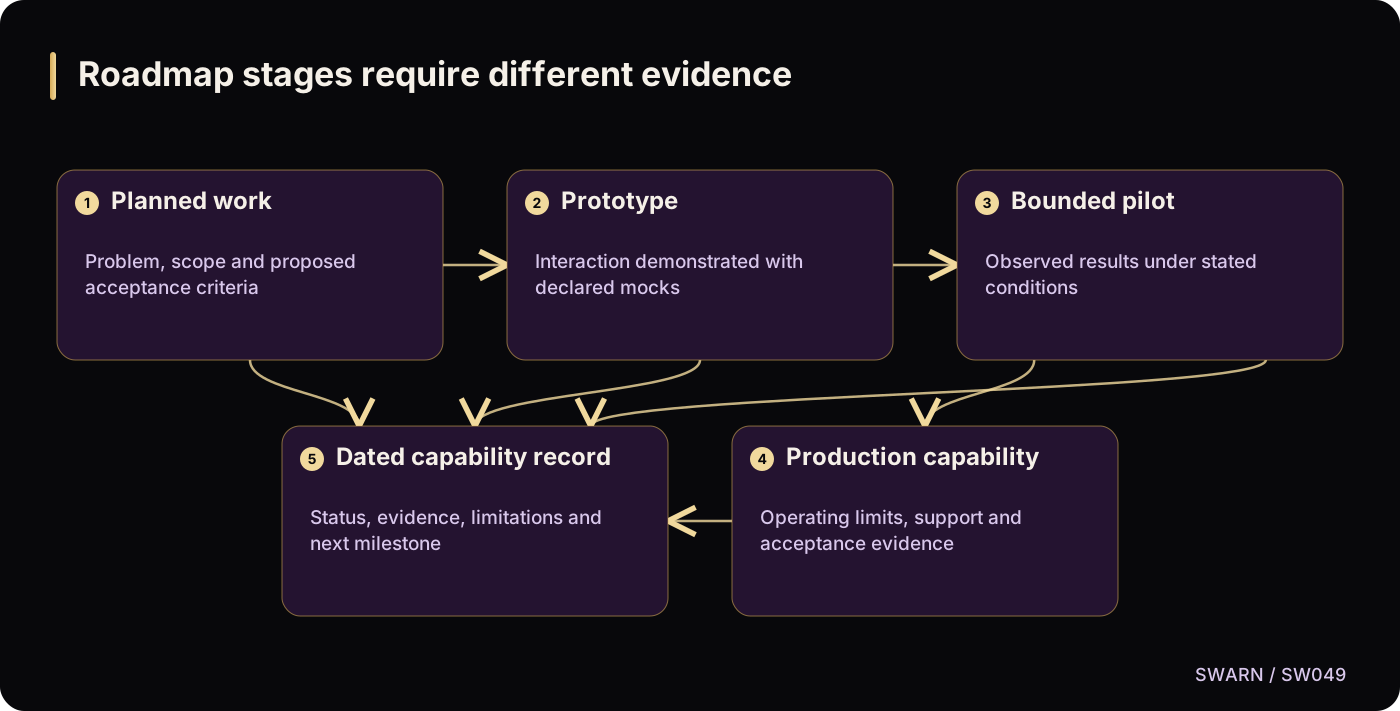
Text version of the diagram
- Planned work: Problem, scope and proposed acceptance criteria
- Prototype: Interaction demonstrated with declared mocks
- Bounded pilot: Observed results under stated conditions
- Production capability: Operating limits, support and acceptance evidence
- Dated capability record: Status, evidence, limitations and next milestone
- Planned work → Prototype
- Prototype → Bounded pilot
- Bounded pilot → Production capability
- Planned work → Dated capability record
- Prototype → Dated capability record
- Bounded pilot → Dated capability record
- Production capability → Dated capability record
Sources and reading context
These references support the original 22 October 2026 research. Source links and the date above make the scope of this article explicit.
- PII detection in different languages · Language configuration
Supports unpacking broad language-support claims
- Evaluating PII detection with Presidio · Use-case evaluation
Supports asking for scoped evidence
- NIST Privacy Framework · Voluntary framework purpose
Supports separating framework use from certification