
Product claims and buying decisions · SW051
Questions to ask before trusting an automated compliance dashboard
Question the scope, evidence and freshness behind a compliance dashboard, and keep unknown controls separate from passing ones before relying on a score.
Research cutoff: . This dated explainer is general information; check the linked instruments and your circumstances before acting.
SWARN is in development. Product workflows described here are design and evaluation guidance; availability depends on the published product status and agreed scope.

A green dashboard can mean that a check passed, that a document was uploaded or that nobody has entered a failure. Those meanings are very different.
Before relying on an automated compliance view, ask what evidence produces each status and what the system cannot observe. The dashboard should help a responsible person make decisions. It should not conceal missing information behind a reassuring percentage.
What exactly does the score measure?
A hypothetical business sees “90% complete” in a privacy dashboard. The percentage may count checklist items equally, even though one missing item concerns an untested deletion path and another concerns an administrative note.
Ask for the denominator, weighting and treatment of unknowns. Does “not applicable” remove an item? Does an unanswered question count as passed, failed or incomplete? Can a critical unresolved issue disappear inside a high average?
A completion score can be useful for project tracking if it is labelled accordingly. It is not automatically a measure of legal compliance or privacy risk.
NIST’s Privacy Framework supports voluntary privacy risk management. Mapping a dashboard to that framework does not turn its score into certification.
Which evidence supports each status?
Separate self-declarations, uploaded documents, automated observations and independently reviewed findings. Each can contribute useful information, but they have different limits.
For example, a policy file may establish that wording exists. It does not prove that staff follow the process. An API check may show that a configuration flag is enabled. It does not prove that every relevant data path uses that configuration.
The hypothetical business should be able to open a status and see its evidence, owner, scope and last review date. If the evidence is restricted, an authorised route should exist without exposing it to every dashboard user.
Keep the relationship between the claim and artefact precise. A penetration-test report is evidence about its stated scope and period, not a universal answer to every privacy obligation.
How does the dashboard handle change?
A new data store, purpose, vendor or software release can make an earlier assessment incomplete. Ask which changes trigger review and which depend on someone updating the inventory manually.
Time alone is not the only freshness measure. A recent review of an outdated system list may still miss the new integration that matters.
The dashboard should display what is stale, unverified or out of scope. Avoid reusing the same green state indefinitely because an item once passed.
NIST’s privacy-engineering objectives include predictability and manageability. Applied as design guidance, a useful dashboard should make processing and its controls understandable enough to act upon.
Does the legal mapping distinguish future duties?
As of 22 October 2026, the DPDP framework has staged commencement. Most substantive business duties and individual rights are scheduled for 13 May 2027 under the commencement notification.
A dashboard should distinguish readiness work for those provisions from presently applicable obligations and organisation-specific requirements. It should also identify the source and version behind a legal mapping.
Under the future accountability provision in section 8(1) of the Act, the Data Fiduciary’s responsibility is not transferred simply by purchasing software. A tool’s status should therefore support the organisation’s assessment rather than purport to replace it.
Avoid importing every requirement from another jurisdiction or applying a role-specific duty to every business without explanation.
What decision follows an unresolved item?
An exception needs an owner, a consequence and a next action. “Review required” is only useful if someone knows what to review and what processing may continue meanwhile.
For the hypothetical business, an unverified deletion integration might block expansion of that workflow, while a documentation improvement could have a different treatment. Record the actual decision instead of treating all open items as interchangeable.
Before accepting the dashboard as a management tool, check:
- Scores have clear denominators and meanings.
- Unknown, stale and not-applicable states remain distinguishable.
- Evidence type, scope and review date are visible.
- Legal mappings include commencement and relevant exceptions.
- Material changes can reopen an assessment.
- Unresolved items lead to owned decisions.
- Product claims remain limited to observed capabilities.
For SWARN, these are design questions for a product in development. No automated score, current capability or compliance outcome is asserted here.
A trustworthy dashboard exposes uncertainty in a usable form. Its strongest contribution is helping people see what the evidence supports and what still requires a decision.
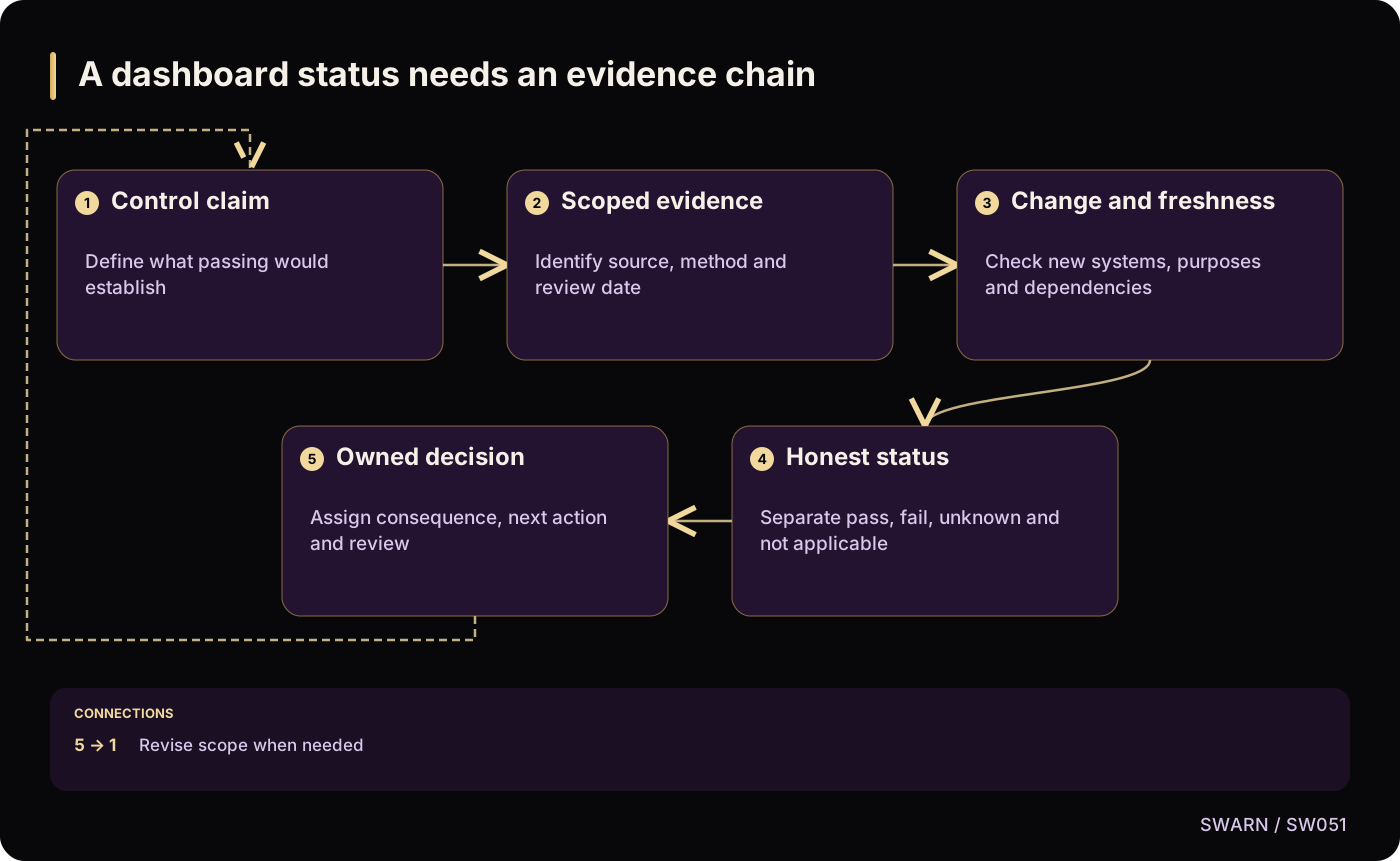
A dashboard status needs an evidence chain
Text version of the diagram
- Control claim: Define what passing would establish
- Scoped evidence: Identify source, method and review date
- Change and freshness: Check new systems, purposes and dependencies
- Honest status: Separate pass, fail, unknown and not applicable
- Owned decision: Assign consequence, next action and review
- Control claim → Scoped evidence
- Scoped evidence → Change and freshness
- Change and freshness → Honest status
- Honest status → Owned decision
- Owned decision → Control claim: Revise scope when needed
Sources and reading context
These references support the original 22 October 2026 research. Source links and the date above make the scope of this article explicit.
- NIST Privacy Framework · Voluntary privacy risk-management framework
Supports distinguishing framework mapping from certification
- NIST IR 8062: An Introduction to Privacy Engineering and Risk Management in Federal Systems · Predictability and manageability
Supports actionable visibility as a design objective
- Commencement notification for provisions of the DPDP Act · Substantive commencement
Supports the readiness distinction
- Digital Personal Data Protection Act, 2023 · Section 8(1)
Supports future Data Fiduciary accountability