
Data inventory · SW016
Keep your inventory useful when teams add new tools
Keep a data inventory current by tying updates to new tools, connectors, exports and supplier changes, then checking the data paths that actually operate.
Research cutoff: . This dated explainer is general information; check the linked instruments and your circumstances before acting.
SWARN is in development. Product workflows described here are design and evaluation guidance; availability depends on the published product status and agreed scope.

A data inventory can become outdated as soon as a team adds a connector. The main application remains the same, but a new service begins receiving support messages, a scheduled export appears or a diagnostics tool starts recording request bodies.
Treat the inventory as part of changing a workflow. The question is not simply whether a new tool has been purchased. It is whether the change creates a new collection, recipient, use, access path or retained copy.
Put the update at the point of change
Choose practical triggers: a new form field, an integration credential, a supplier trial, an export schedule, a model endpoint or a changed retention setting. These are moments when the team already has to make a decision.
Add a short inventory check to that decision. What information will move? For which purpose? Who receives it? Where is it retained? Who owns the arrangement? What happens if the tool is removed?
Keep the questions proportional. A change that adds a new recipient of customer messages deserves more attention than a cosmetic label update. The review should follow the information flow and consequence, not the size of the software release.
Include experiments and temporary tools
A hypothetical home-services company tries an AI assistant to summarise customer complaints. Staff export a small set of tickets to a trial account, planning to delete them after the demonstration.
The trial has already created a data path. Calling it temporary does not answer who can access the uploaded files, what the service retains or whether attachments were included. The inventory should identify the trial owner and approved data scope before the upload happens.
NIST’s Generative AI Profile recommends inventorying third parties with access to organisational content. For this example, that means looking beyond the visible assistant to any OCR, model, hosting or connected service involved.
Use synthetic records where they can answer the trial’s question. If real data is necessary, resolve the handling and approval requirements explicitly rather than allowing the evaluation to create an undocumented production copy.
Update the map from evidence
A procurement form describes intended use. An operating inventory should also be checked against what the workflow actually does.
Inspect a controlled test transaction. Identify the outbound destinations, payload fields, storage locations and logs it produces. Use authorised tools and avoid collecting unnecessary personal content during the inspection.
OpenTelemetry’s sensitive-data guidance reminds implementers to understand what their instrumentation emits. A new observability library can change the data path even when the customer-facing feature has not changed.
Automated discovery can help locate systems or candidate sensitive fields. It does not automatically establish the purpose, legal ground, accountable owner or correct retention decision. Keep those human decisions linked to the technical evidence.
Make removal a first-class event
The inventory should change when a tool is retired, not only when it is introduced. Record whether credentials were revoked, scheduled jobs stopped, retained copies addressed and dependent workflows updated.
In the hypothetical AI trial, closing the account is only one step. The team should check the exported source file, any local working copies, the trial’s output and any downstream reports created from it.
Do not claim that deletion occurred merely because the inventory status changed to retired. Keep the evidence appropriate to each location and record limitations where a supplier’s process has not yet completed.
If a tool remains for a limited retention purpose, make that status explicit. “No longer actively used” and “no longer holds data” describe different states.
Assign a reviewer who understands the change
The person updating the inventory needs access to the relevant design and supplier information. A central privacy coordinator may maintain the register, but the team making the change should provide the facts.
Use a review trigger when the purpose, recipient or deployment changes materially. A tool approved for synthetic demonstrations should not silently become a destination for live customer records.
A practical change checklist is:
- Identify new or altered data flows.
- Compare the actual payload with the approved scope.
- Record recipients and supporting services.
- Confirm owners and access paths.
- Review retention, export and removal behaviour.
- Update the inventory before broad rollout.
- Verify a controlled transaction after configuration.
Keep a history of meaningful changes so reviewers can understand earlier processing. The inventory’s value comes from remaining close enough to the work that a new tool leaves a visible, explainable trace in the organisation’s data map.
A tool change updates the inventory
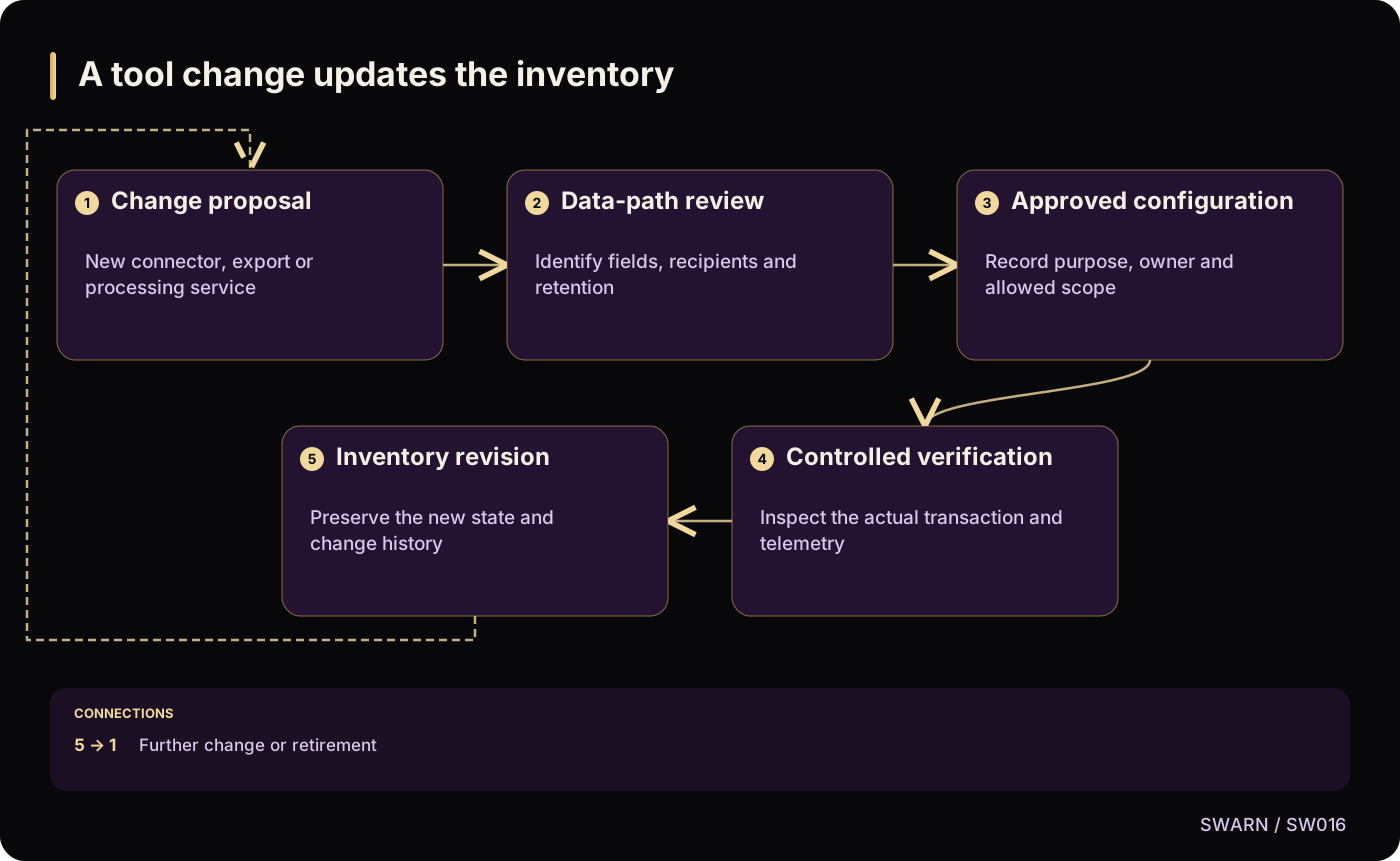
Text version of the diagram
- Change proposal: New connector, export or processing service
- Data-path review: Identify fields, recipients and retention
- Approved configuration: Record purpose, owner and allowed scope
- Controlled verification: Inspect the actual transaction and telemetry
- Inventory revision: Preserve the new state and change history
- Change proposal → Data-path review
- Data-path review → Approved configuration
- Approved configuration → Controlled verification
- Controlled verification → Inventory revision
- Inventory revision → Change proposal: Further change or retirement
Sources and reading context
These references support the original 22 October 2026 research. Source links and the date above make the scope of this article explicit.
- NIST AI 600-1: Artificial Intelligence Risk Management Framework: Generative Artificial Intelligence Profile · GV-6.1-007: inventory third parties with content access
Track services with content access
- Handling sensitive data · Instrumentation responsibility
Review telemetry emitted by changes