
Integration design · SW036
Make a deletion job observable from request to confirmation
Track a deletion job from authorised scope to system-level confirmation, with explicit retention exceptions, retries and evidence for unresolved work.
Research cutoff: . This dated explainer is general information; check the linked instruments and your circumstances before acting.
SWARN is in development. Product workflows described here are design and evaluation guidance; availability depends on the published product status and agreed scope.

A deletion job should be able to answer a simple question: what has happened to the data in each system within its scope?
A single progress bar rarely supplies that answer. The job may have removed an active record, queued a processor request, invalidated a cache and encountered a retention requirement elsewhere. Those are different outcomes, and the completion model should preserve them.
Decide the scope before scheduling work
A hypothetical subscription business accepts an erasure request. It identifies the relevant person, assesses the request and determines which data can be erased and which must be retained for a documented reason.
The technical job should receive that authorised scope. It should not infer a legal retention decision from a database error or treat every record with a matching email address as the same person’s data.
The DPDP Act’s sections 8(7) and 12 set out different erasure routes. Section 8(7) links erasure to withdrawal or the end of purpose, whichever is earlier, unless retention is necessary for compliance with law. Section 12’s erasure right concerns consent-based processing, including section 7(a), with purpose and legal-retention qualifications. The final Rules, rule 8(3), provide at least one year of retention from processing for personal data, associated traffic data and processing logs for the Seventh Schedule purposes, subject to the text’s further-retention conditions. These provisions need to inform the target-by-target decision.
As of 22 October 2026, the relevant core regime is scheduled for 13 May 2027 under the commencement notification. This is a readiness workflow; applicable current and sector-specific requirements need separate assessment.
Give each target an explicit state
The job may include a primary database, search index, file store and external processor. For each target, record what action is required and what result will establish completion.
Useful states might distinguish not started, accepted, running, confirmed, blocked and retained under an approved exception. Define them against the target’s actual behaviour.
A processor’s receipt acknowledgement may show that the request entered its queue. It may not show that deletion has finished. A database command may succeed while a derived index still serves the content.
Keep the overall case open or qualified where required evidence remains outstanding. Avoid treating a timeout as either proof of failure or proof of success.
Make retries safe and visible
Network uncertainty can leave a worker unsure whether an action occurred. A retry mechanism should avoid harmful duplicate effects and preserve the relationship to the original request.
AWS’s guidance on idempotent APIs explains why stable request identity and coordinated operation state matter for retries. Apply the principle according to each target’s capabilities rather than assuming every deletion API has the same contract.
Record attempts separately from outcomes. An increasing attempt count can reveal a stuck job, but it does not establish how much data was removed.
Use a job reference that remains stable across worker restarts. Keep target-specific request identifiers linked to it, so a replacement worker or operator can reconcile an uncertain attempt without creating a new, unrelated deletion case.
Set a route for repeated failure or an unsupported target. The operator should see the affected system, the last meaningful result and the next permitted action without needing access to the deleted payload.
Confirm active and derived stores
The subscription business should check the relationships between source records, attachments, chunks, indexes and caches. Deleting the primary row does not necessarily clear its derivatives.
Some stores expose changes with eventual consistency. Pinecone’s deletion documentation, under Data freshness is one product-specific example. Confirmation should follow the chosen system’s documented semantics, with a visible pending state where necessary.
Backups may follow a different lifecycle from active stores. Document that treatment, including controls against restoring erased data into active use without reapplying relevant instructions. Do not label the entire data estate cleared when the evidence covers only active retrieval.
Where data is retained for an approved reason, record the limited purpose, access treatment and review point. An exception should not become a general permission to continue unrelated use.
Produce a closure account
The final record should be concise enough for a case owner to understand and detailed enough to support later review. It can reference restricted evidence rather than copying personal data into the job log.
Before closure, check:
- The subject and data scope were authorised.
- Every required target has a defined result or explicit unresolved status.
- Retry records distinguish attempts from confirmed outcomes.
- Derived stores and relevant external processors are accounted for.
- Retained data has a recorded reason and controlled treatment.
- The customer-facing explanation matches what the evidence establishes.
The job’s operational value lies in making uncertainty manageable. A clear partial result with an owner and next action is more useful than an unqualified success label issued before all required systems have responded.
Deletion completion is a per-target decision
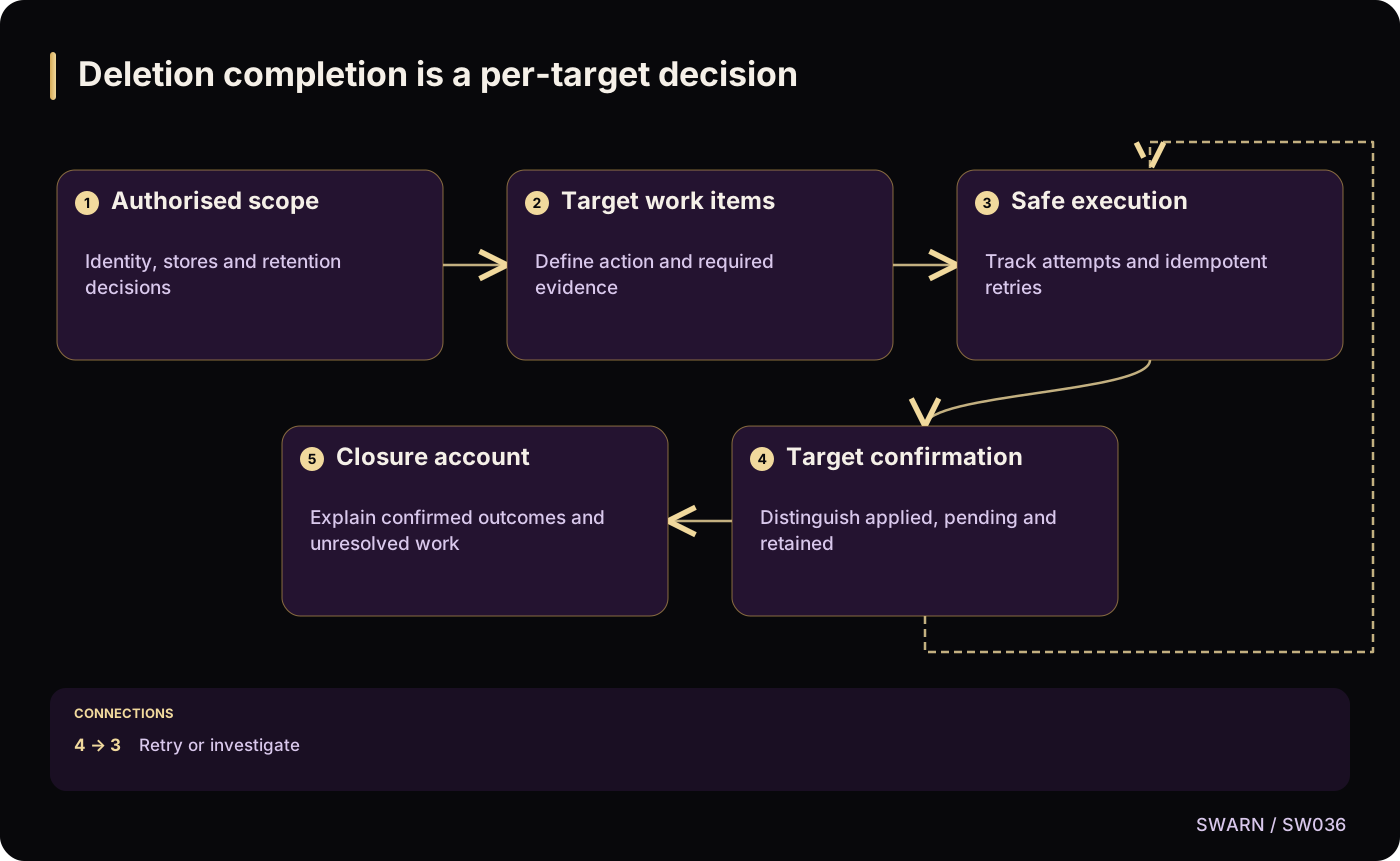
Text version of the diagram
- Authorised scope: Identity, stores and retention decisions
- Target work items: Define action and required evidence
- Safe execution: Track attempts and idempotent retries
- Target confirmation: Distinguish applied, pending and retained
- Closure account: Explain confirmed outcomes and unresolved work
- Authorised scope → Target work items
- Target work items → Safe execution
- Safe execution → Target confirmation
- Target confirmation → Safe execution: Retry or investigate
- Target confirmation → Closure account
Sources and reading context
These references support the original 22 October 2026 research. Source links and the date above make the scope of this article explicit.
- Digital Personal Data Protection Act, 2023 · Sections 8(7) and 12
Supports qualified future erasure requirements
- Digital Personal Data Protection Rules, 2025 · Rule 8(3) and Seventh Schedule
Supports assessing final retention provisions
- Commencement notification for provisions of the DPDP Act · Phased commencement
Supports the dated readiness context
- Making retries safe with idempotent APIs · Idempotent operations
Supports safe retry design
- Delete data · Data freshness
Provides a bounded example of confirmation semantics