
Integration design · SW034
How a suppression list protects a withdrawal across systems
Use a purpose-scoped suppression record to stop old imports and queued campaigns from reviving withdrawn messaging permissions across systems.
Research cutoff: . This dated explainer is general information; check the linked instruments and your circumstances before acting.
SWARN is in development. Product workflows described here are design and evaluation guidance; availability depends on the published product status and agreed scope.

Deleting a customer from a campaign list may stop today’s send while leaving tomorrow’s import free to add them again. A suppression mechanism addresses that different problem: it records that a particular use should remain blocked unless a valid later decision changes it.
The design needs care. A suppression list can itself contain personal data, and an overbroad block can interfere with unrelated services. The useful question is which processing purpose must stop and which systems could accidentally restart it.
State the purpose being suppressed
A hypothetical retailer receives a withdrawal from promotional messages. The person still has an open delivery order and may need service updates.
The suppression record should identify the relevant purpose and channel or destination where required. It should not automatically mean “never communicate for any reason”. Conversely, renaming a promotional campaign should not bypass the same underlying restriction.
Under section 6(4) to 6(6) of the DPDP Act, the future consent framework provides for withdrawal and cessation of consent-based processing within a reasonable time, including processing by processors, subject to processing required or authorised by law. As of 22 October 2026, these core provisions are scheduled for 13 May 2027 under the commencement notification. This article describes a readiness design, not a claim about a presently operative universal suppression-list duty.
The legal basis and purpose of any continued communication still need assessment. A technical category called “transactional” does not decide that question by itself.
Find the routes that can recreate permission
The retailer may have a CRM, a campaign platform, a spreadsheet upload and an agency preparing seasonal messages. A withdrawal applied only in the CRM leaves the other routes unresolved.
List every process that creates or selects an audience. Apply the relevant preference or suppression check when importing, preparing and sending, as appropriate to the architecture. A list prepared before withdrawal may need revalidation before dispatch.
Older data deserves particular attention. A restored backup or an archived campaign file can reintroduce a stale opt-in. Define how those sources obtain the current preference state before they become active.
The suppression record is a guard against stale instructions. It should be connected to the authoritative preference model, rather than becoming a second independent truth with different rules.
Retain only the matching information needed
A suppression service needs enough information to match the relevant subject or contact point. It usually does not need a full customer profile or the original conversation.
Choose the matching method deliberately. A stable account reference may work for authenticated customers, while a contact-point-based workflow raises different matching and ownership questions. Shared or reassigned contact details need an explicit policy rather than an assumption that a number permanently identifies one person.
Hashing a predictable contact value is not automatic anonymisation. OpenTelemetry’s sensitive-data guidance explains the risk of matching predictable values against candidates. Although that guidance concerns telemetry, the same limitation matters when evaluating a hashed suppression field.
Control access to the record, its matching service and any restoration information. Document retention against the purpose and applicable requirements. Do not keep an entire withdrawn profile merely because one minimal matching reference remains necessary.
Define valid changes to the block
A later affirmative choice may change a person’s preference, but an old import or an administrator’s convenience edit should not be treated as that choice.
Record the source, purpose, relevant notice version and authority for a state change. Preserve the earlier withdrawal in the event history while updating the current decision according to the defined rules.
If an identity match is uncertain, provide a review route. Automatically suppressing the wrong person or restoring the wrong permission can both be harmful.
For integrations, distinguish “suppression received” from “sending control updated”. A central record has limited value if the platform that sends messages does not consult or apply it.
Test revival attempts
Use synthetic customers to rehearse a withdrawal followed by an old-file import, a queued campaign, a restored backup and a valid later preference change.
The test should establish:
- The correct purpose is blocked across relevant sending routes.
- Unrelated permitted processing is not automatically disabled.
- Stale imports cannot override a newer withdrawal.
- Matching errors and shared contact points have a defined resolution.
- Downstream application is visible, including failures.
- The suppression record contains only justified information.
A suppression list succeeds when it makes withdrawal durable across the operational paths that could undo it. Its scope and evidence matter as much as the presence of a row in a database.
Protect withdrawal from stale audience sources
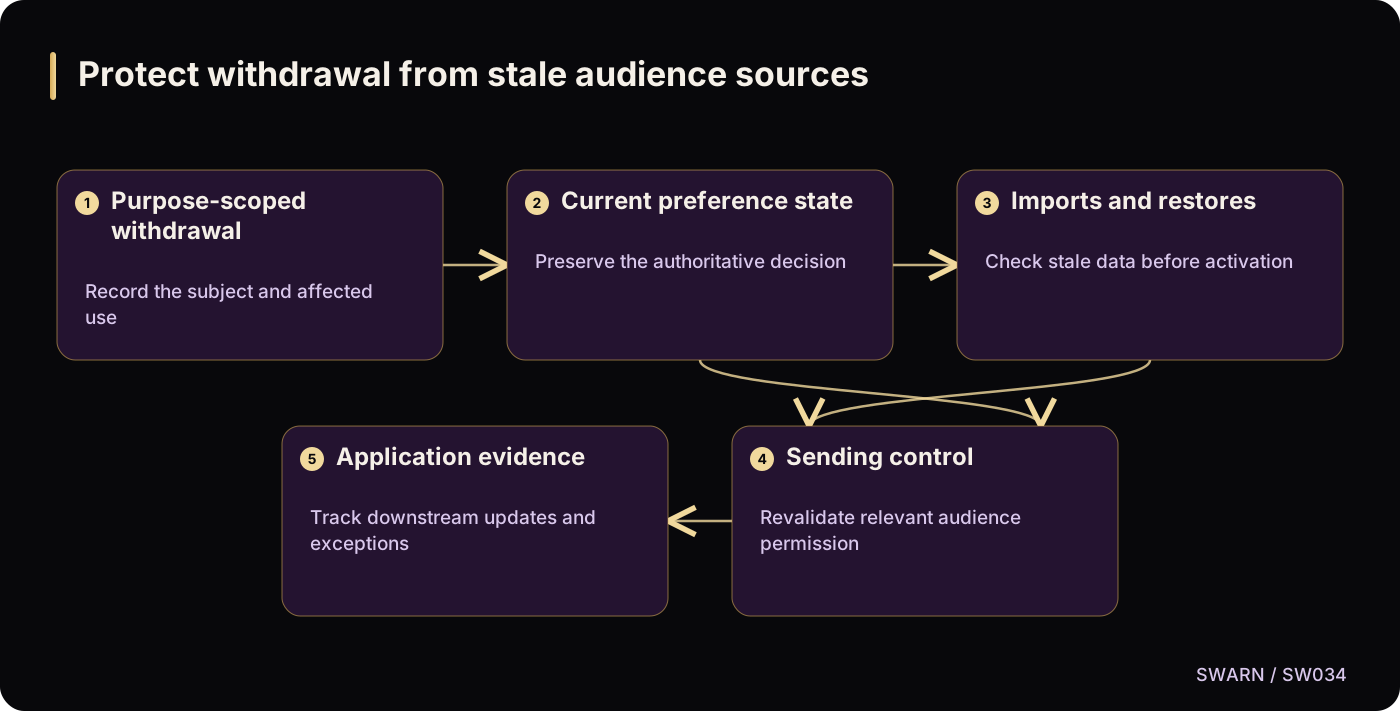
Text version of the diagram
- Purpose-scoped withdrawal: Record the subject and affected use
- Current preference state: Preserve the authoritative decision
- Imports and restores: Check stale data before activation
- Sending control: Revalidate relevant audience permission
- Application evidence: Track downstream updates and exceptions
- Purpose-scoped withdrawal → Current preference state
- Current preference state → Imports and restores
- Imports and restores → Sending control
- Current preference state → Sending control
- Sending control → Application evidence
Sources and reading context
These references support the original 22 October 2026 research. Source links and the date above make the scope of this article explicit.
- Digital Personal Data Protection Act, 2023 · Section 6(4)-(6)
Supports the future withdrawal scope and legal exception
- Commencement notification for provisions of the DPDP Act · Phased commencement
Supports the dated readiness context
- Handling sensitive data · Limitations of hashing predictable data
Supports the matching-field privacy caveat