
Consent experience · SW006
Make the purpose visible before the customer chooses
Make a consent purpose understandable by connecting each requested field to a concrete use, recipient and consequence before the customer decides.
Research cutoff: . This dated explainer is general information; check the linked instruments and your circumstances before acting.
SWARN is in development. Product workflows described here are design and evaluation guidance; availability depends on the published product status and agreed scope.

A customer should be able to understand what a business wants to do before deciding whether to agree. Phrases such as “for a better experience” leave too much work to the reader. They may cover delivery updates, advertising, profiling or several unrelated activities.
Write the purpose from the customer’s point of view, then check that the underlying workflow does what the wording says. A clear sentence cannot repair a system that sends the information somewhere else for an unexplained use.
Begin with the action you intend to take
Use a simple working question: what will the business actually do with this field? If the answer is “store it”, ask why storage is needed and what later action it supports.
For a hypothetical meal-preparation service, a delivery address helps send an order to the customer. A telephone number may help resolve a delivery problem. Using that number to invite the customer to a weekly promotional group is a separate action that needs its own assessment.
The DPDP Act’s notice and consent provisions connect personal data with specified purposes. The final Rules, particularly rule 3, describe notice content and usability. They do not prescribe a universal marketing sentence or a fixed number of checkboxes.
As of 22 October 2026, these substantive provisions are scheduled for 13 May 2027 under the commencement notification. A team preparing now should distinguish that future DPDP phase from requirements already applicable to its business.
Build a purpose sentence from concrete parts
Try a working structure: “We use [information] to [specific action], so that [customer-facing result].” Then ask whether a recipient or channel must be explained for the reader to understand the use.
For the meal service, a draft might explain that the delivery address is shared with the delivery partner to complete the order. The customer should not have to discover the partner’s involvement after providing the information.
Do not turn the sentence into a dense catalogue of every technical operation. Database replication and internal queue names rarely help a customer decide. Explain the meaningful processing, while maintaining the detailed data-flow record internally.
Test every word that expands the purpose. “Related”, “including”, “partners” and “other services” can quietly widen a sentence until it no longer describes a bounded activity. Replace vague extensions with a defined use or a separate explanation.
Check the sentence against the fields
A purpose can look clear while the form still asks for unnecessary information. If the task is to notify someone when a repair is ready, why does the form ask for a full date of birth? If the answer is an unrelated future campaign, the original purpose has not explained that collection.
Create a small field review:
| Field | Intended action | Decision to resolve |
|---|---|---|
| Delivery address | Deliver the chosen order | Who needs the full address? |
| Telephone number | Resolve delivery problems | Which channels will be used? |
| Dietary preference | Prepare the requested meal | Is a free-text medical history necessary? |
| Promotional preference | Send chosen offers | Is participation separate and optional? |
This is a hypothetical design exercise. The correct field set depends on the service and legal analysis. The value of the table is that it makes hidden assumptions available for review.
Let people explain the purpose back to you
Ask a test participant what they expect after reading the screen. Would they expect one delivery call, recurring advertisements or sharing with another business? Where their interpretation differs from the planned workflow, investigate the wording and the workflow together.
Include the language options relevant to the audience. Sections 5(3) and 6(3) of the Act describe access to notice and consent requests in English or an Eighth Schedule language. Do not turn that into a claim that every screen must display every language simultaneously.
Keep translated versions connected to the same approved meaning. If one version says “order updates” and another implies general offers, the issue is substantive, not merely cosmetic.
Treat a changed purpose as a decision
When a team proposes a new use, compare it with the purpose already explained and the applicable ground. Do not assume that an existing record marked “consented” covers the new activity. A purpose reference should identify what the person actually chose.
Before publishing a consent request:
- Name the action the information enables.
- Check each field for necessity to that action.
- Explain meaningful sharing and channels.
- Separate unrelated choices.
- Review translations for equivalent meaning.
- Confirm that the product and receiving systems honour the stated scope.
- Record who approves future purpose changes.
The purpose should remain visible in operational decisions after collection. When a team exports an audience or creates a new integration, the same description can help them determine whether the proposed use belongs within the original workflow.
Check purpose against the actual workflow
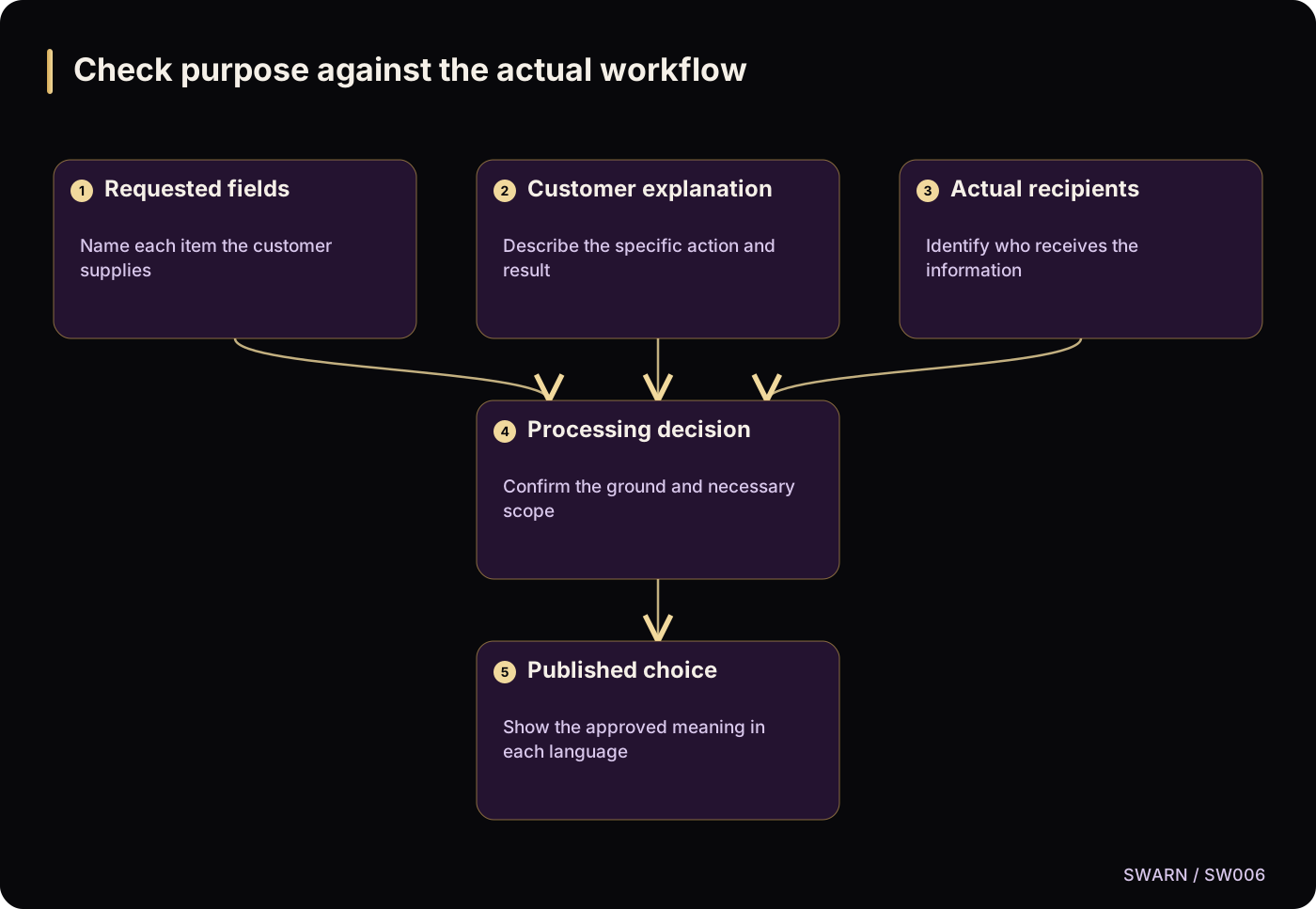
Text version of the diagram
- Requested fields: Name each item the customer supplies
- Customer explanation: Describe the specific action and result
- Actual recipients: Identify who receives the information
- Processing decision: Confirm the ground and necessary scope
- Published choice: Show the approved meaning in each language
- Requested fields → Processing decision
- Customer explanation → Processing decision
- Actual recipients → Processing decision
- Processing decision → Published choice
Sources and reading context
These references support the original 22 October 2026 research. Source links and the date above make the scope of this article explicit.
- Digital Personal Data Protection Act, 2023 · Sections 5 and 6
Notice, purpose and language provisions
- Digital Personal Data Protection Rules, 2025 · Rule 3
Final notice requirements
- Commencement notification for provisions of the DPDP Act · Paragraph (c)
Substantive commencement phase