
Consent experience · SW007
Withdrawal needs to reach the systems that send messages
Make withdrawal reach the systems that prepare and send messages, with purpose-specific decisions, failed-delivery handling and verified completion.
Research cutoff: . This dated explainer is general information; check the linked instruments and your circumstances before acting.
SWARN is in development. Product workflows described here are design and evaluation guidance; availability depends on the published product status and agreed scope.

A customer who stops promotional messages is interested in the next message, not the state of an internal preference screen. A withdrawal workflow therefore needs to reach the systems that decide who receives a campaign, including systems that already hold an exported audience.
Start at the sending end and work backwards. Identify every place that can create, schedule or send the affected message. Then determine how each place learns that the customer’s choice has changed.
Define the purpose being withdrawn
A single customer record may support several activities. Delivery updates, account security notices and promotional campaigns should not automatically share one permission flag. The business needs a reviewed basis for each purpose and an understandable way to apply the relevant choice.
Sections 6(4) to 6(6) of the DPDP Act address withdrawal, comparable ease and cessation of consent-based processing within a reasonable time, including processing by processors, with the stated qualification for processing authorised or required by law. Withdrawal does not retrospectively invalidate earlier lawful processing.
These substantive duties are scheduled for 13 May 2027 under the commencement notification, as checked on 22 October 2026. The following workflow is preparation for that phase, not a claim that all future provisions already apply.
Avoid promising that withdrawal deletes every record immediately. Stopping a promotional use, retaining evidence of the choice and handling records subject to legal retention are related but different decisions.
Find the points where old choices survive
Consider a hypothetical homeware retailer. Its website stores preferences, its marketing team downloads a campaign list, and a messaging provider schedules the campaign. A customer withdraws after the download but before sending begins.
Updating the website alone leaves two possible copies of the older decision. The team needs to know whether the local campaign list is checked again and whether the provider supports cancellation or eligibility refresh.
Add less obvious paths: spreadsheets reused from a previous campaign, staff-created contact groups, abandoned scheduled jobs and imported customer lists. Do not assume that an integration named “sync” covers every one of them. Ask what it synchronises, in which direction and when.
A processing inventory should make those paths visible. Each destination needs an owner and a specific method of applying the withdrawal.
Separate acknowledgement from effective change
A proposed event might carry an internal subject reference, the purpose, the new state and a unique event identifier. Keep the payload limited to what the destination needs. Sending the customer’s entire profile with every change creates unnecessary copies.
The destination should return a meaningful result. “Received” means that the update arrived. “Applied” means that the relevant eligibility decision changed. A rejected identifier or unavailable service should remain visible as unfinished work.
If the delivery mechanism retries, ensure that repeating the same change does not cause a conflicting result. AWS’s guidance on idempotent APIs explains why retries need a defined contract that avoids unintended additional effects. The exact implementation depends on the receiving service.
Do not let a late older event restore a withdrawn preference. The team needs a version or other ordering rule that reflects the current authoritative decision, rather than assuming network delivery order is always meaningful.
Decide what happens while propagation is incomplete
The business should choose a fallback for the affected purpose. For a promotional campaign, holding uncertain recipients out of a batch may be appropriate. For a separate essential service message, the analysis may differ.
Document who can pause a campaign and who resolves a failed update. The operator should see the purpose affected, the failing system, the last attempt and the next action. Avoid a broad “ignore errors” option that lets a campaign proceed without a decision.
The customer-facing confirmation should match the verified state. If the system accepts the request immediately but downstream work remains pending, the wording must not claim that every destination has already completed the change.
Rehearse the full route
Use synthetic customer records to test withdrawal before audience creation, after export and during a provider outage. Include duplicate records and a later import of an older list.
For each sending path, check:
- Which purpose and customer identity does the change affect?
- Where is the current decision authoritative?
- Can a stale export override that decision?
- Are failed updates owned and retried safely?
- Can pending sends be stopped or excluded?
- What evidence proves the final eligibility outcome?
- How are retained records kept from re-entering campaigns?
Close the test only when the receiving systems’ behaviour is visible. The preference screen remains important, but the operational result is established where the next promotional action is allowed or prevented.
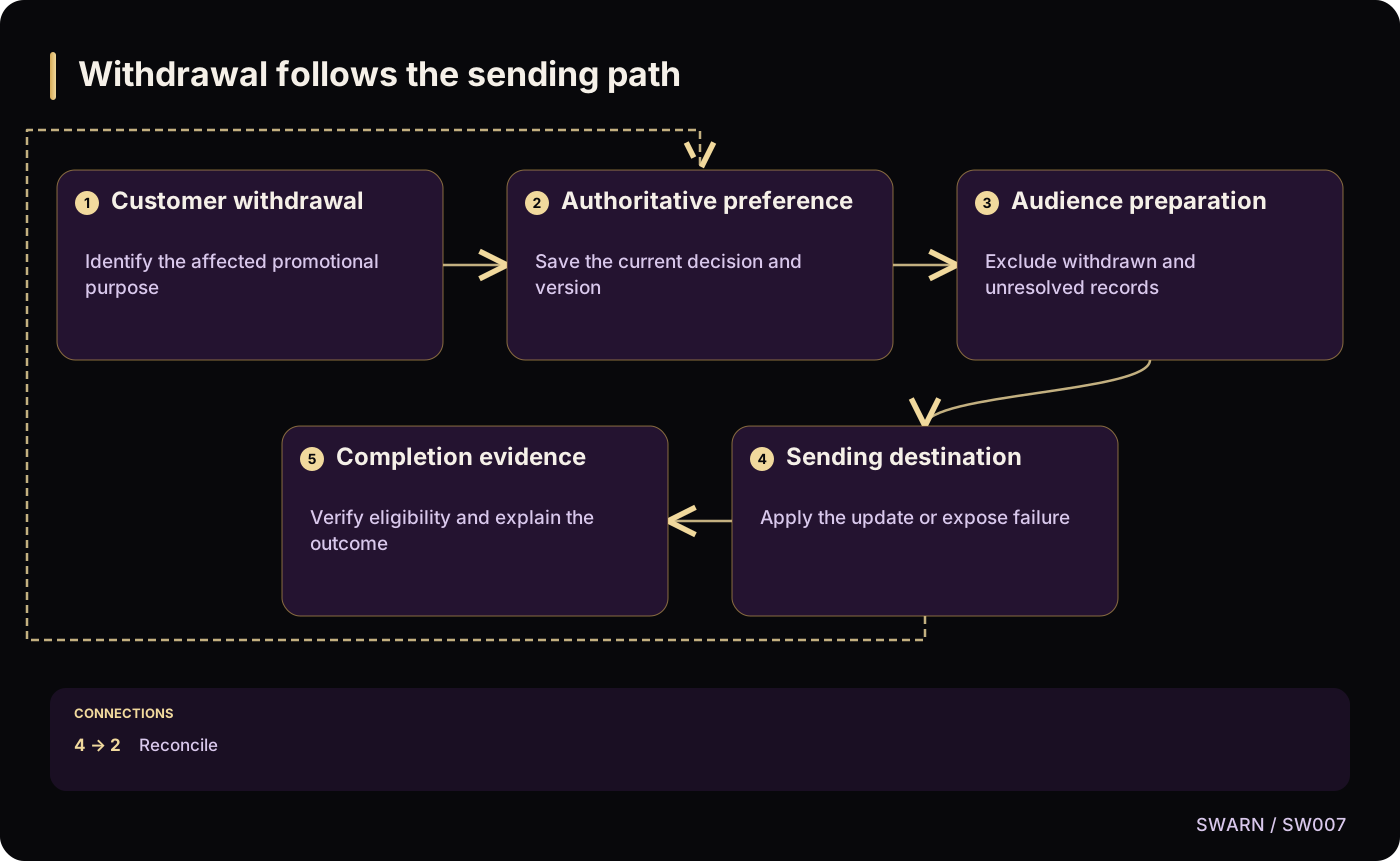
Withdrawal follows the sending path
Text version of the diagram
- Customer withdrawal: Identify the affected promotional purpose
- Authoritative preference: Save the current decision and version
- Audience preparation: Exclude withdrawn and unresolved records
- Sending destination: Apply the update or expose failure
- Completion evidence: Verify eligibility and explain the outcome
- Customer withdrawal → Authoritative preference
- Authoritative preference → Audience preparation
- Audience preparation → Sending destination
- Sending destination → Completion evidence
- Sending destination → Authoritative preference: Reconcile
Sources and reading context
These references support the original 22 October 2026 research. Source links and the date above make the scope of this article explicit.
- Digital Personal Data Protection Act, 2023 · Sections 6(4) to 6(6)
Withdrawal and cessation boundaries
- Commencement notification for provisions of the DPDP Act · Paragraph (c)
Commencement context
- Making retries safe with idempotent APIs · Idempotent operations
Safe retries for downstream changes