
Integration design · SW035
Plan a CRM integration around scoped access and test records
Plan a CRM privacy integration around the fields and actions it needs, with restricted credentials, synthetic records and evidence for denied operations.
Research cutoff: . This dated explainer is general information; check the linked instruments and your circumstances before acting.
SWARN is in development. Product workflows described here are design and evaluation guidance; availability depends on the published product status and agreed scope.

A CRM integration should not begin with an administrator token and a promise to reduce access later. Start with the exact workflow the integration must perform, then derive the fields, operations and accounts it needs.
For a privacy workflow, those needs may be narrower than a general synchronisation connector. Reading a preference status, applying a withdrawal and reporting an acknowledgement do not automatically require access to sales notes, attachments or every customer record.
Write the integration contract in business terms
Consider a hypothetical retailer connecting its preference service to a CRM. The intended outcome is to update promotional messaging permissions for a matched customer and return a reliable result.
Describe the allowed input, matching rule, permitted update and expected output. State which system owns the authoritative preference and how conflicts are resolved. Define what happens when the CRM contains duplicate or ambiguous matches.
This contract should be understandable before anyone reads the API specification. It gives the technical review a stable purpose against which to assess requested permissions.
A connector that can “sync contacts” may expose far more than this workflow needs. Ask which fields it reads and writes in practice, including automatic enrichment or debug paths.
Derive permissions from operations
List the smallest set of API operations required for the contract. Separate read access from write access, and distinguish updating a preference from exporting or deleting a customer record.
OWASP’s authorisation guidance recommends least privilege, default denial and validating access for each request. Apply those principles to the integration’s service identity as well as to human users.
Where the CRM’s permission model is coarser than the workflow needs, record the gap. Additional application controls may reduce exposure, but they do not make a broad credential narrow. The production decision should acknowledge the residual capability.
Use separate credentials or identities for separate environments and duties where supported. A test connector should not silently gain production access because configuration was copied.
Build test records before connecting live data
Create synthetic customers with clearly documented fixture origins. Include a normal match, an ambiguous match, a missing record and a record outside the integration’s permitted scope.
The test environment should also contain unrelated fields that the connector is not supposed to read. Distinctive synthetic markers make unnecessary collection visible in request traces and exports.
Avoid using a copy of the production CRM as a convenient sandbox without an approved data decision. A non-production label does not remove the privacy implications of the data inside it.
Check both directions of the integration. A minimal outbound update can trigger a verbose response containing a full record, and a logging layer may preserve that response.
OpenTelemetry’s sensitive-data guidance supports minimising what diagnostic systems collect. Include connector logs, failed payloads and support bundles in the inspection.
Test denied operations as deliberately as successful ones
The retailer’s integration should update the allowed preference field. It should also fail safely when asked to change an unrelated field, access another tenant or act on an unresolved identity match.
A successful API call proves only that the credential can perform that action. It does not prove that the credential lacks other capabilities. Review the granted scopes and test relevant negative cases.
If a provider offers a sandbox, follow its documented limitations. Behaviour in a sandbox may differ from production, so record which assumptions still require verification in a controlled production check.
Do not claim an integration is production-ready merely because a demonstration record changed colour in a dashboard.
Prepare the operating handover
The owner of the CRM connection needs a procedure for credential rotation, revoked access, rate limits, failures and schema changes. The service should distinguish an authentication failure from an ordinary unmatched customer.
Give operators a narrow exception view with the reason, affected workflow and next action. Avoid displaying full customer profiles just because a sync failed.
Before approval, assemble:
- The business contract and authoritative-state decision.
- The granted permission inventory and any excess capability.
- Test evidence for allowed and denied actions.
- The fields observed in requests, responses and logs.
- A credential and failure-response owner.
- The rollback or disconnect procedure and its effect on pending work.
A scoped integration is easier to explain and review because every permission has a job. Where the platform cannot provide the ideal boundary, the evidence should show that limitation clearly enough for a responsible deployment decision.
Derive CRM access from the workflow
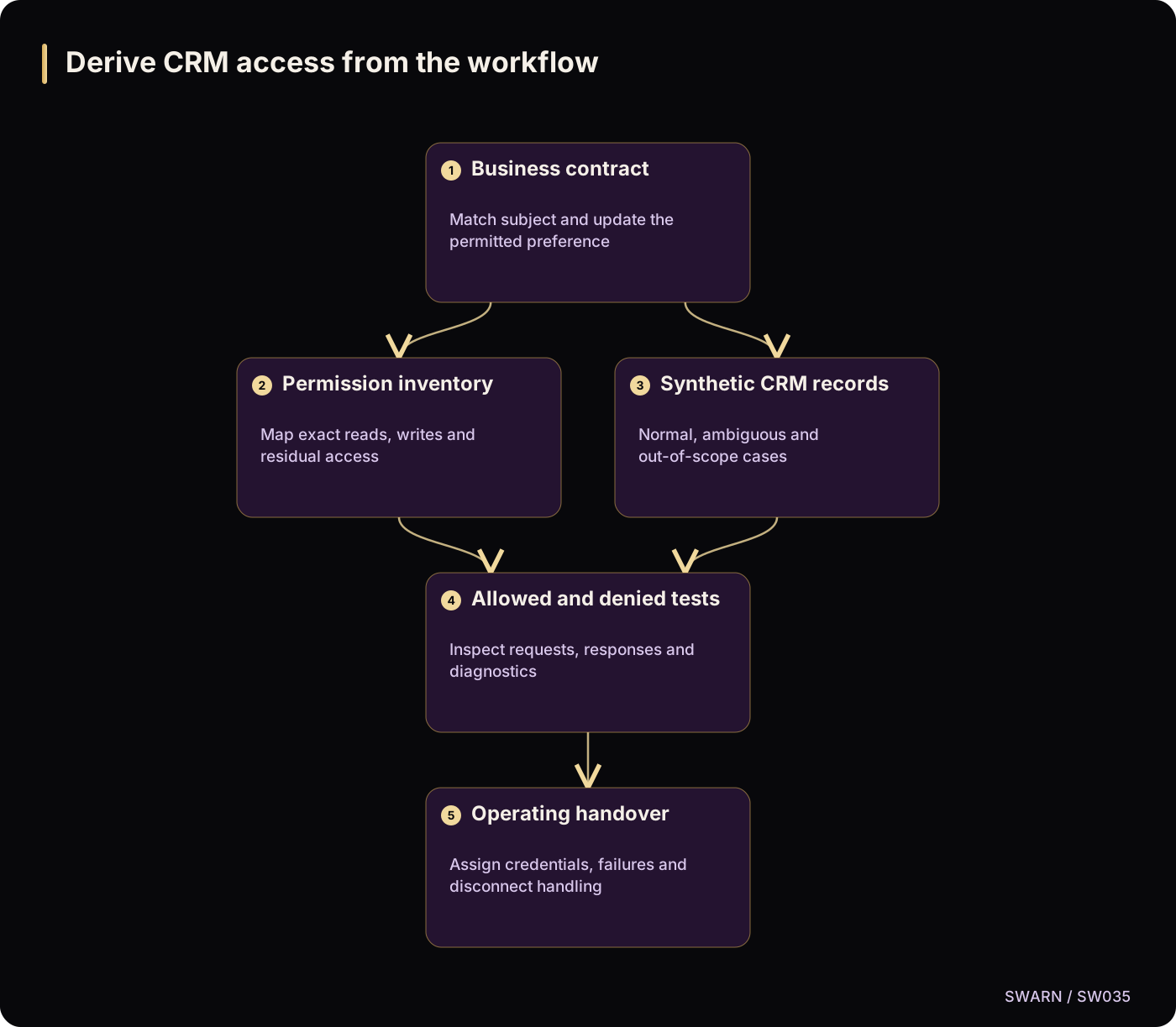
Text version of the diagram
- Business contract: Match subject and update the permitted preference
- Permission inventory: Map exact reads, writes and residual access
- Synthetic CRM records: Normal, ambiguous and out-of-scope cases
- Allowed and denied tests: Inspect requests, responses and diagnostics
- Operating handover: Assign credentials, failures and disconnect handling
- Business contract → Permission inventory
- Business contract → Synthetic CRM records
- Permission inventory → Allowed and denied tests
- Synthetic CRM records → Allowed and denied tests
- Allowed and denied tests → Operating handover
Sources and reading context
These references support the original 22 October 2026 research. Source links and the date above make the scope of this article explicit.
- Authorization Cheat Sheet · Least privilege and request checks
Supports permission scoping and denied-case testing
- Handling sensitive data · Telemetry minimisation
Supports inspection of connector diagnostics