
Workflow design · SW001
Start with one customer journey before choosing privacy software
Choose privacy software by mapping one real customer journey, its decisions, handoffs and evidence before comparing features or buying a platform.
Research cutoff: . This dated explainer is general information; check the linked instruments and your circumstances before acting.
SWARN is in development. Product workflows described here are design and evaluation guidance; availability depends on the published product status and agreed scope.

A privacy software demonstration becomes easier to judge when you bring a specific customer journey into the room. Choose something your team actually needs to operate: a repair booking, a loyalty enrolment, an order update or a request to stop promotional messages. Follow that journey far enough to see where the information travels and who makes each decision.
The useful first output is a short description of the workflow you want to improve. A catalogue of features can come later. Without that description, two tools may appear comparable while solving different problems, and an attractive dashboard may conceal an unresolved handoff.
Draw the journey from the customer’s first action
Consider a hypothetical tailoring business. A customer supplies a name and telephone number so the shop can confirm when an alteration is ready. Staff enter the details into a spreadsheet. Another colleague occasionally exports that spreadsheet to prepare festival promotions.
These are distinct operational steps. The export introduces a different use and may introduce another recipient or system. Write both down, even if the same employee performs them. The DPDP Act’s definitions of Data Fiduciary and processing focus on actual purposes, means and activities. A software label does not determine the role.
For each step, record five things: the information involved, the intended purpose, the system holding it, the person responsible and the next recipient. Where the answer is uncertain, mark it as an open question. A visible gap is more useful than a reassuring assumption.
Include the customer-facing end of the journey. If someone changes a telephone number, declines promotions or asks a question, identify where that action is received and what should change. A journey that ends at collection misses much of the operating work.
Choose one outcome worth testing
For the tailoring business, a sensible first outcome might be: promotional lists include only customers eligible for that particular purpose under the business’s approved policy. This is narrower and more testable than “make the business compliant”.
The outcome needs a boundary. Does it cover the main spreadsheet, handwritten notes that are later entered, an external messaging service and staff phones? If the pilot covers only the spreadsheet export, say so. Keep the other paths in a backlog with named owners.
NIST’s Privacy Framework is a voluntary risk-management tool. Its value here is the discipline of connecting an identified privacy risk with a decision and evidence. It does not certify a purchase or replace the business’s legal analysis.
As of 22 October 2026, the DPDP framework has phased commencement. The substantive provisions discussed in readiness work are scheduled for 13 May 2027 under the commencement notification. Existing applicable obligations still require separate attention.
Take the awkward cases into the demonstration
Ask a supplier to work through cases that make the chosen outcome difficult. A customer has two records. An employee imports an older spreadsheet. The messaging service is unavailable. Someone changes their preference while a campaign is being prepared. A supervisor needs to explain why a record was excluded.
Use synthetic records for the demonstration. Give each case an expected result before the supplier starts. Otherwise, an unexpected outcome can easily be reframed as a feature.
Request evidence for three different moments: what the customer chose, what the system decided and what the receiving system actually did. A screen displaying “withdrawn” proves little about a file already exported to another service. Conversely, a failed integration should remain visible as unfinished work rather than silently becoming a successful result.
The supplier may reasonably explain that some steps require configuration, custom integration or manual handling. Record that distinction. A demonstrated built-in capability, a configurable workflow and a roadmap item should not receive the same evaluation score.
Keep the selection decision proportionate
The first journey should reveal enough complexity to test the approach, while remaining small enough for your team to understand. Avoid selecting a workflow merely because it makes the demonstration easy. Avoid combining every department into the first exercise.
Before shortlisting software, complete this practical check:
- Name the customer action and the business outcome.
- List every system and human handoff inside the pilot.
- Identify the decision that currently lacks reliable evidence.
- Agree the difficult cases and expected results.
- Assign someone to resolve failures and integration gaps.
- Define what would justify expansion, revision or stopping.
Also decide what the team will do if the software is unavailable. A manual export with an old preference list may undo the control you are evaluating. An agreed temporary process is part of the workflow.
The purchase decision can then be specific: this tool, with these integrations and operating responsibilities, has demonstrated these outcomes within this boundary. That is a decision colleagues can review. It gives the next pilot a clear starting point and prevents a small successful demonstration from becoming an unsupported promise about the whole organisation.
From one journey to a reviewable selection
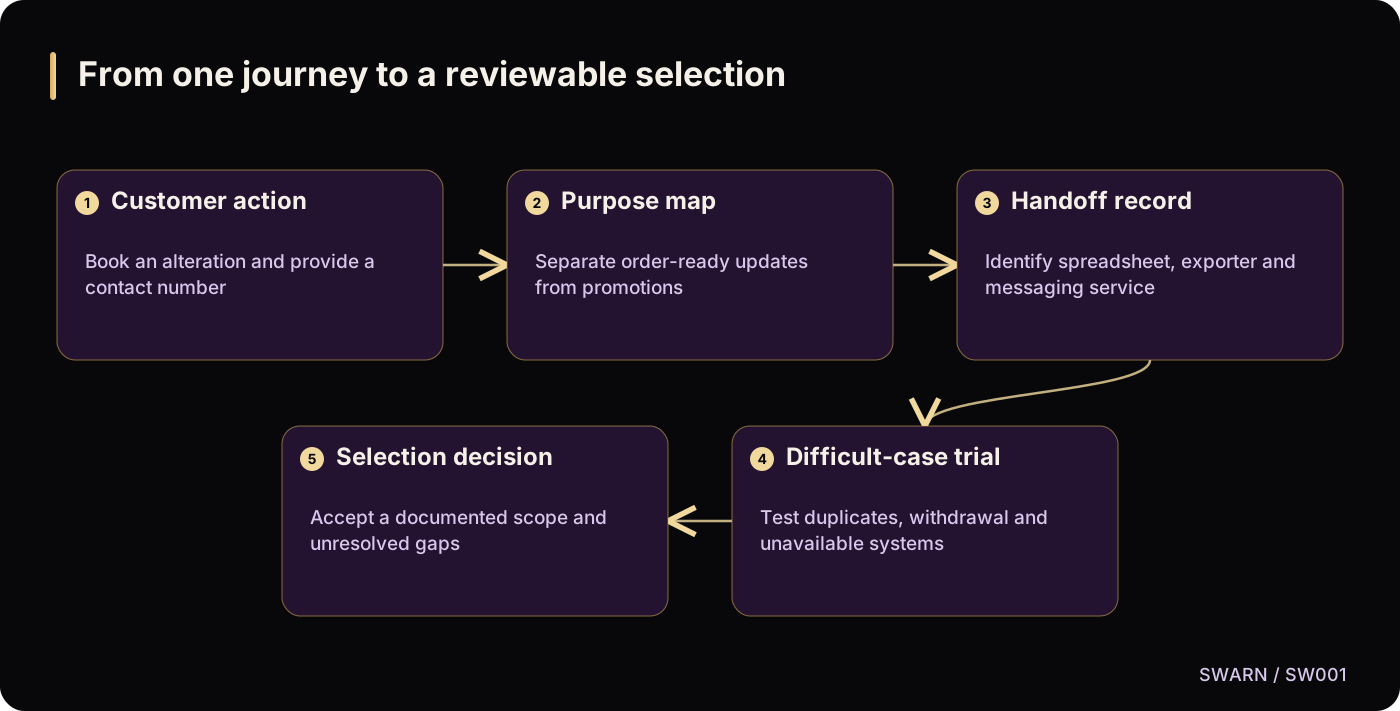
Text version of the diagram
- Customer action: Book an alteration and provide a contact number
- Purpose map: Separate order-ready updates from promotions
- Handoff record: Identify spreadsheet, exporter and messaging service
- Difficult-case trial: Test duplicates, withdrawal and unavailable systems
- Selection decision: Accept a documented scope and unresolved gaps
- Customer action → Purpose map
- Purpose map → Handoff record
- Handoff record → Difficult-case trial
- Difficult-case trial → Selection decision
Sources and reading context
These references support the original 22 October 2026 research. Source links and the date above make the scope of this article explicit.
- Digital Personal Data Protection Act, 2023 · Sections 2(i), 2(x)
Definitions attach to actual activity
- NIST Privacy Framework · Framework overview
Voluntary privacy risk management
- Commencement notification for provisions of the DPDP Act · Paragraph (c)
Substantive commencement phase