
Workflow design · SW003
Turn a policy promise into an observable product behaviour
Translate a privacy promise into observable behaviour with a trigger, system boundary, testable outcome and evidence that survives review.
Research cutoff: . This dated explainer is general information; check the linked instruments and your circumstances before acting.
SWARN is in development. Product workflows described here are design and evaluation guidance; availability depends on the published product status and agreed scope.

“We respect your choices” is a useful intention, but a developer cannot implement it until the team decides what should happen when a choice changes. A privacy requirement becomes workable when it identifies a trigger, the systems affected and an outcome someone can observe.
Start with one sentence from a policy or customer notice. Ask what a customer would reasonably expect the product to do because of that sentence. Then turn that expectation into a requirement with a clear scope and a test.
Write the behaviour before choosing the control
Suppose a hypothetical appointment service promises that customers can stop promotional reminders. The product team proposes a preference toggle. The toggle is an interface element; the behaviour is the consequence of using it.
A stronger requirement reads: when an authenticated customer withdraws the promotional-reminder preference, the service records the decision, updates promotional eligibility and prevents the affected sending paths from using an older preference state. The team must define how pending messages are handled and what happens during integration failure.
This wording still needs decisions. Which reminders are promotional? Which appointment messages have a different purpose? Which identity records represent the same customer? Do not hide unresolved questions behind the phrase “all systems”.
NIST IR 8062 describes predictability, manageability and disassociability as privacy-engineering objectives. Here, predictability asks whether the customer’s expectation matches the system’s behaviour; manageability asks whether the organisation can actually apply the change.
Identify evidence at the right boundary
The evidence should show more than a successful button click. A useful trace might connect the request, the applicable policy version, the eligibility update and the decision made by the sending component.
For the hypothetical appointment service, test the final decision before sending. If an external provider accepts a message batch hours earlier, the team also needs to understand whether queued items can be cancelled. The requirement may need to distinguish a request that can still be stopped from a message already delivered.
The DPDP Act’s consent-withdrawal provisions recognise withdrawal and address stopping consent-based processing, subject to the stated legal qualification. As of 22 October 2026, these provisions belong to the substantive phase scheduled for 13 May 2027 under the commencement notification. The product design should prepare for that duty without asserting a made-up instantaneous cancellation requirement.
The team can adopt a stricter internal service target when justified. Label it as the business’s target, and test whether the whole workflow can meet it.
Test the promise from both directions
A positive test checks that an eligible synthetic customer receives the intended promotional workflow. A negative test checks that an ineligible synthetic customer does not enter that workflow. Both are needed. A system that blocks everyone may satisfy a narrow “nothing was sent” check while failing its legitimate purpose.
Add cases that cross a boundary: an old import, a duplicate customer record, a retry, a cached audience and a delayed background job. These are proposed tests, not claims that a particular product has these defects.
Observe the actual result. An empty application log may mean that nothing happened, or that logging failed. A green integration status may mean that the receiver accepted an event, not that the receiver changed its decision. Pair assertions with evidence from the component responsible for the outcome.
Make exceptions part of the requirement
Some cases will require review. A customer may have withdrawn one purpose but retained another. A record may need restricted retention for an applicable legal requirement. A receiver may be unavailable.
State what the system should do while the exception is open. For example, the business may hold the affected promotional action until eligibility can be established. That is an operational policy choice that should be reviewed for the workflow, not a universal prescription for every service.
The exception record needs an owner, the reason for uncertainty, the next action and the evidence needed to close it. Avoid a generic override that lets any operator ignore the original requirement.
A practical acceptance checklist
Before calling the promise implemented, ask:
- Is the triggering customer action unambiguous?
- Are purpose and identity scope defined?
- Does every covered sending path enforce the decision?
- Are pending, retried and cached actions addressed?
- Can an authorised reviewer explain a failure?
- Is completion evidence separate from receipt evidence?
- Does the customer-facing wording describe the verified boundary?
Keep the requirement next to the relevant tests and policy version. When marketing introduces a new campaign system or engineering changes the queue, the promise should trigger a review of those dependencies. A policy statement remains useful only if the team can find the behaviour it describes and demonstrate that behaviour under the conditions customers will encounter.
Turn a promise into an acceptance test
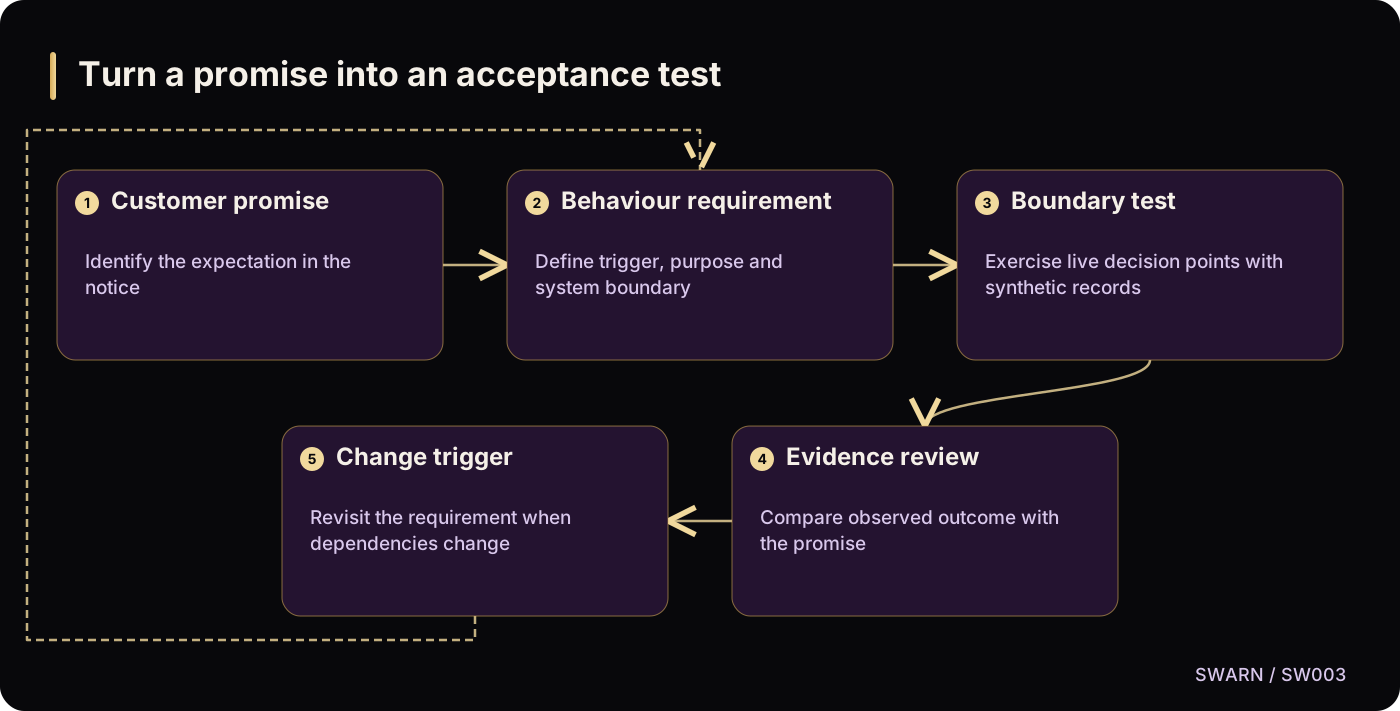
Text version of the diagram
- Customer promise: Identify the expectation in the notice
- Behaviour requirement: Define trigger, purpose and system boundary
- Boundary test: Exercise live decision points with synthetic records
- Evidence review: Compare observed outcome with the promise
- Change trigger: Revisit the requirement when dependencies change
- Customer promise → Behaviour requirement
- Behaviour requirement → Boundary test
- Boundary test → Evidence review
- Evidence review → Change trigger
- Change trigger → Behaviour requirement
Sources and reading context
These references support the original 22 October 2026 research. Source links and the date above make the scope of this article explicit.
- NIST IR 8062: An Introduction to Privacy Engineering and Risk Management in Federal Systems · Privacy engineering objectives
Connection between expectations and controllable behaviour
- Digital Personal Data Protection Act, 2023 · Sections 6(4) to 6(6)
Consent-withdrawal provisions
- Commencement notification for provisions of the DPDP Act · Paragraph (c)
Substantive commencement timing