
Pilot adoption · SW048
What to learn from a failed privacy workflow pilot
Investigate a failed privacy pilot by locating the broken decision or handoff, preserving evidence and choosing a specific repair or a justified stop.
Research cutoff: . This dated explainer is general information; check the linked instruments and your circumstances before acting.
SWARN is in development. Product workflows described here are design and evaluation guidance; availability depends on the published product status and agreed scope.

A pilot that cannot complete its intended workflow has produced a decision problem. The team needs to establish what failed, which consequences matter and whether a bounded repair can address the cause.
Calling the pilot “unsuccessful” is too broad to guide the next step. Calling it “valuable learning” without a concrete finding is equally unhelpful. Preserve the evidence and identify the point where observed behaviour diverged from the agreed outcome.
Reconstruct one failed case
Imagine a hypothetical pilot in which a withdrawal appears complete in the central dashboard, but the campaign platform still shows the earlier preference.
Start with that case’s timeline. What instruction was captured? Which identity match was used? What event was emitted? What response came back? Which condition caused the dashboard to display completion?
Do not begin by assuming that the connector is broken or that staff used the system incorrectly. Both are possible, but the evidence should distinguish them from a status-definition error, an authorisation problem or a delayed update.
OWASP’s logging guidance supports preserving useful event information and protecting it against alteration. Use controlled references to relevant evidence rather than copying customer payloads into a broad postmortem document.
Separate the failure layers
A workflow may fail because its purpose was unclear, because responsibility was missing, because a user could not understand the interface or because a technical component behaved incorrectly.
For the withdrawal example, the connector may have successfully delivered a request while the dashboard incorrectly treated receipt as application. Repairing delivery retries would not fix that interpretation.
Alternatively, the matching process may have updated a different customer record. That requires attention to identity and scope, even if every API call returned success.
Write the failure as a precise statement: “The completion rule accepted a receipt acknowledgement before target-state confirmation.” This is more actionable than “The integration was unreliable”.
NIST’s privacy-engineering objectives include predictability and manageability. They provide a useful lens for asking whether operators could understand the behaviour and control the unresolved processing.
Check consequences before restarting
Determine whether the failed pilot used synthetic fixtures or affected real operational data. If real data or customer instructions were involved, route the consequences through the organisation’s authorised incident, request or operational process as appropriate.
Do not assume that every failed test is a reportable breach. Equally, do not dismiss an actual exposure or unfulfilled instruction as harmless because it happened during a pilot. The assessment depends on the facts and applicable requirements.
Pause the specific path that cannot meet its required conditions. A narrow pause may be sufficient, but it should prevent further unsupported completion claims while investigation continues.
Preserve necessary evidence under controlled access and avoid retaining unrelated personal data simply because a review has begun.
Choose a repair that addresses the finding
For the status-definition failure, the repair could change the completion condition, expose a pending state and add target-state reconciliation. The revised test should reproduce the original failure and establish that the new behaviour handles it.
For an unclear ownership failure, additional code may not help. Assigning responsibility and giving the operator an escalation route may be the necessary change.
For a detector-coverage failure, narrow the accepted input or improve and evaluate the recogniser. Do not remove difficult cases from the pilot pack to improve the headline result.
Record the proposed repair, owner, evidence required and decision date. Include the possibility that the dependency cannot meet the workflow’s needs.
Decide whether another pilot is justified
A repeat should have a new question, not merely another demonstration of the same ideal path. Explain what uncertainty the next run will resolve and why the team can now resolve it.
Before restarting, confirm:
- The failed case has a supportable reconstruction.
- The cause is separated from its visible symptoms.
- Consequences for real data or instructions have an owner.
- The repair addresses the identified cause.
- The original failure is retained as a regression case.
- Stop conditions and remaining limitations are explicit.
A justified stop can be the right outcome when access, evidence or a required provider capability is unavailable. The pilot record should make that choice understandable to the next team.
The useful lesson is the decision that changes: a completion rule, an access boundary, a responsibility or the deployment scope. Preserve that decision with its evidence so the same uncertainty does not return disguised as a new pilot.
Turn a failed pilot into a specific decision
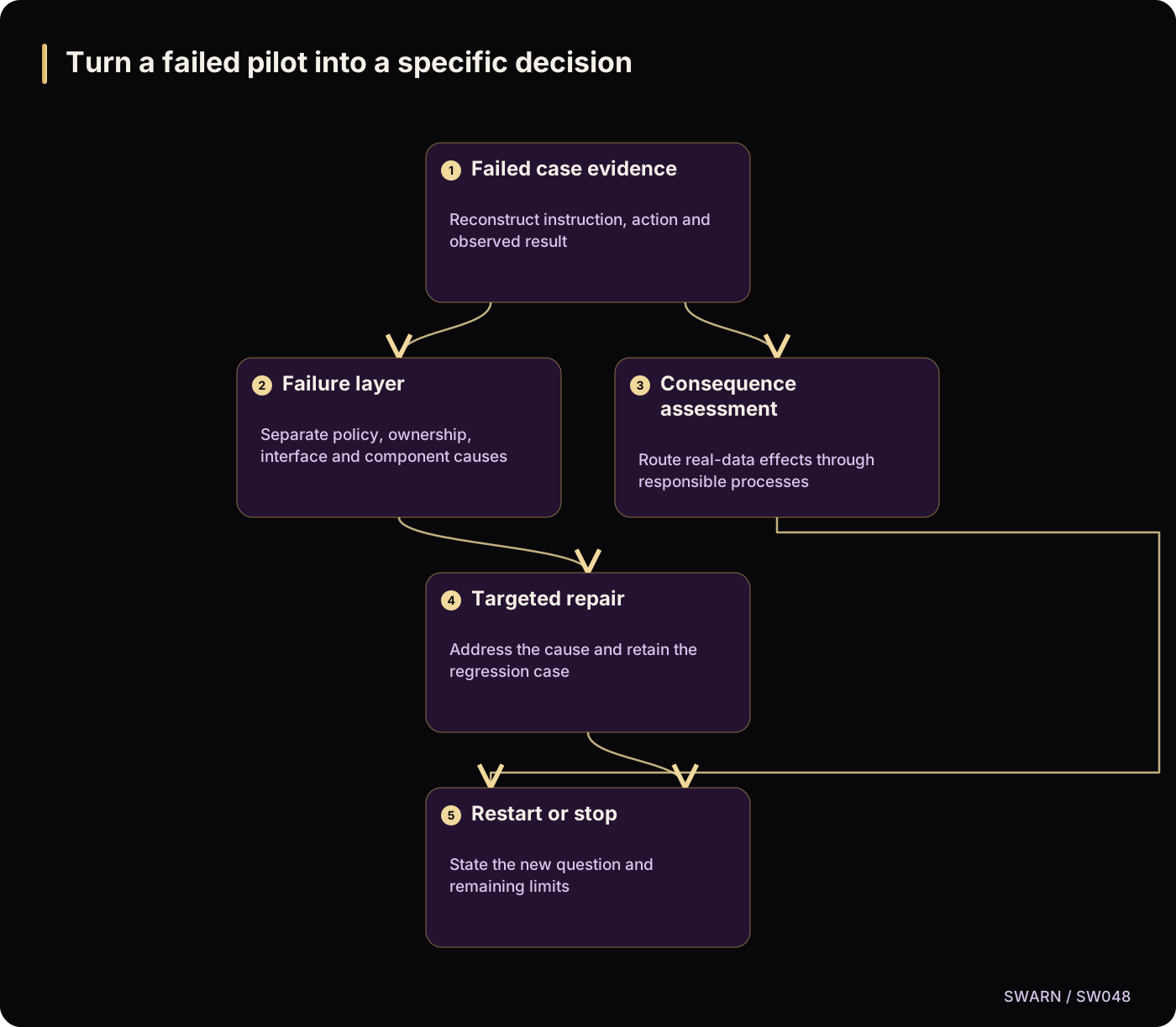
Text version of the diagram
- Failed case evidence: Reconstruct instruction, action and observed result
- Failure layer: Separate policy, ownership, interface and component causes
- Consequence assessment: Route real-data effects through responsible processes
- Targeted repair: Address the cause and retain the regression case
- Restart or stop: State the new question and remaining limits
- Failed case evidence → Failure layer
- Failed case evidence → Consequence assessment
- Failure layer → Targeted repair
- Consequence assessment → Restart or stop
- Targeted repair → Restart or stop
Sources and reading context
These references support the original 22 October 2026 research. Source links and the date above make the scope of this article explicit.
- OWASP Logging Cheat Sheet · Reliable and protected event evidence
Supports reconstructing the failed workflow
- NIST IR 8062: An Introduction to Privacy Engineering and Risk Management in Federal Systems · Predictability and manageability
Supports evaluating whether behaviour could be understood and controlled